Building Your Talent Pipeline - Talent Dashboards
Talent dashboards are far more than a “nice-to-have” for modern HR teams — they’ve become mission-critical tools that empower HR leaders and organizational decision-makers with real-time, data-driven insights that dramatically improve how they attract, retain, and develop people.
In today’s talent market, organizations must move beyond intuition to a strategy grounded in measurable evidence. With a robust talent dashboard, HR leaders transform raw data into actionable insights — enabling decisions that are strategic, confident, and directly tied to business outcomes.
What Is a Talent Dashboard?
By definition, a talent dashboard is a centralized reporting and measurement system that aggregates key HR data across functions into a single source of truth. It visually shows critical workforce indicators — such as recruitment efficiency, engagement health, performance trends, and retention signals — in real time, enabling HR teams and business leaders to monitor, act, and plan with confidence.
With cloud-based platforms and analytics engines, dashboards are no longer static reports but live systems that update automatically and support interactive exploration of trends and correlations. (Source)
Why Tracking HR Metrics Matters More Than Ever
The era of “measuring HR for measurement’s sake” is over. Today’s talent dashboards are tied directly to organizational performance:
📊 Organizations Lean Into Metrics
94% of organizations now track employee turnover rates.
89% monitor time-to-fill positions.
Companies that track 15 or more HR metrics report 23% better business outcomes than peers with lighter measurement programs.
These figures show that the most competitive employers use data as the foundation of how they attract, engage, and retain talent. (Source)
Core Metrics Every Talent Dashboard Should Track
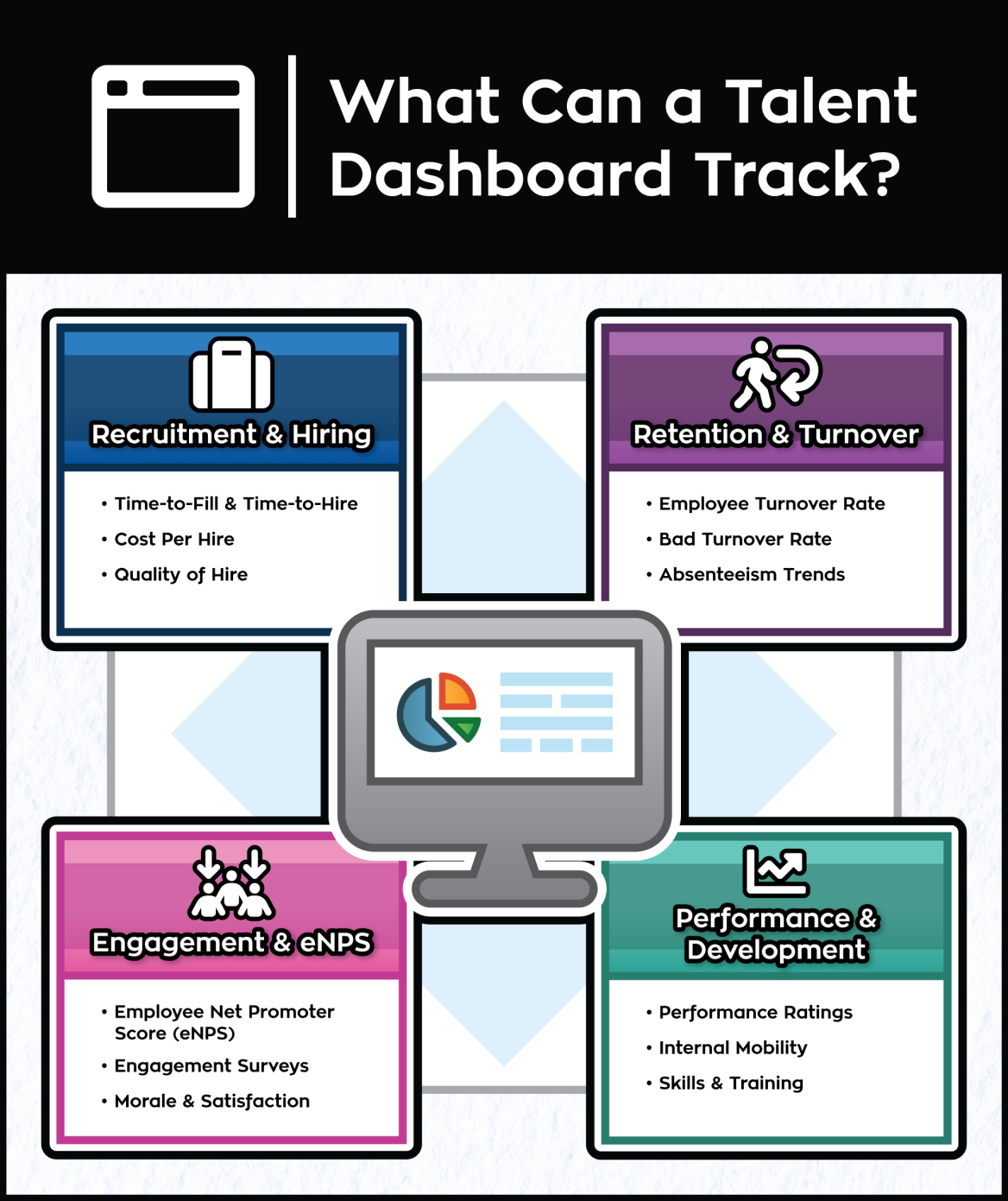
Different organizations may tailor their dashboards, but the most impactful metrics include:
🔹 Recruitment & Hiring Indicators
Time-to-Fill – Measures time from job requisition to offer acceptance. A consistent industry benchmark is roughly 30–45 days for most roles.
Time-to-Hire – Focuses more narrowly on speed between candidate application and offer acceptance. (Source)
Cost-per-Hire – Total recruiting cost per new hire, showing investment efficiency.
Quality of Hire – Tracks performance and retention of new hires over time, indicating recruiting impact. (Qualitative but highly predictive.)
Retention & Talent Stability
Employee Turnover Rate – One of the most universally tracked HR metrics.
Bad Turnover Rate – A subset capturing unwanted or avoidable departures (e.g., involuntary turnover or voluntary exits from top performers).
Absenteeism & Leave Patterns – Helps highlight morale or wellbeing challenges. (Source)
Engagement & Experience Metrics
Employee Net Promoter Score (eNPS) – Measures loyalty and willingness to recommend the organization as a workplace (promoters minus detractors).
Many companies now include eNPS as a standard pulse metric because it correlates with retention and culture health.
Engagement Scores – Often collected through periodic surveys and trend-tracked for alignment with organizational initiatives.
Performance & Development Insights
Performance Ratings Distribution – Reveals workforce capability and helps identify underperforming or high-potential groups.
Internal Mobility & Upskilling Rates – Captures success in developing and retaining talent from within.
The Power of Centralized HR Analytics
Building a talent dashboard unlocks several core advantages that go beyond basic reporting:
🚀 Better Decision Making
By integrating data from HRIS, applicant tracking systems, performance reviews, and engagement surveys, dashboards enable smarter, faster decisions — replacing guesswork with evidence-based strategy.
📉 Early Issue Detection
Dashboards highlight early warning signs (e.g., rising attrition in a key department) and allow HR leaders to intervene before problems escalate.
📅 Strategic Workforce Planning
Rather than reacting to short-term events, dashboards help forecast future talent needs and skill gaps — keeping workforce readiness aligned with business goals. (Source)
⏱ Time Efficiency & Accuracy
Automation removes manual reporting bottlenecks and creates accurate, auditable HR data around the clock.
How eNPS Fits Into the Talent Story
While every organization’s needs differ, Employee Net Promoter Score (eNPS) often emerges as one of the most telling indicators of organizational health:
Why eNPS Matters
Simple yet powerful: eNPS focuses on employees’ likelihood to recommend your workplace — a core reflection of culture, engagement, and satisfaction. (Source)
Predictive of outcomes: High eNPS scores have been linked to stronger employer reputation and lower turnover — creating a virtuous cycle for talent attraction and retention.
Broadly actionable: When used alongside objective metrics (like turnover or performance), eNPS helps HR leaders prioritize the why behind trends and guide targeted interventions.
Because it blends both sentiment and strategical insight, many HR leaders treat eNPS as a leading indicator — one that reliably signals evolving workforce conditions.
From Data to Action: Making Metrics Matter
A dashboard shouldn’t just display numbers — it should support workforce action:
🔍 Focus on Insights Over Volume
Rather than overwhelming users with every possible metric, dashboards should prioritize metrics that inform real decisions. If a metric cannot be tied to an action, it’s likely noise.
📈 Monitor Trends Over Time
True value comes from tracking trends — not just snapshots. Dashboards with historical views help identify shifts before they become crises.
🧠 Align With Business Outcomes
Leading dashboards tie talent metrics directly to business performance — from revenue per employee to customer satisfaction, engagement, and organizational resilience.
In Summary
In an era where people are a company’s most strategic asset, talent dashboards are indispensable. They turn raw HR data into actionable insights that drive stronger organizational performance, deeper employee engagement, and smarter workforce planning. Because if you can’t measure it, you can’t improve it.
Learn More!
Learn more about EDSI's Talent Management Strategy here or watch this video of EDSI's Managing Partner Jim Bitterle presenting about talent dashboards and how they can help you fill your talent pipeline!
