Turnaround & Restructuring: An Expert Q&A on Recognizing Distress and Taking Action

EDSI ·

When a business begins to struggle, recognizing the signs early – and acting quickly – can make the difference between recovery and closure.

In this Q&A blog, EDSI’s Managing Partner of Consulting, Jim Bitterle, shares insights from years of helping organizations navigate financial distress, stabilize operations, and return to profitability.

Jim Bitterle
Jim Bitterle - EDSI Consulting Managing Partner

Q: What does it mean when a company is “in distress”?

Jim:
At its core, distress is really about financial pressure – and nine times out of ten, that pressure shows up in cash flow. I always tell people, “revenue is vanity, profit is sanity, but cash is reality.” If a company is burning through cash or getting close to the limits of its credit, that’s when the alarm bells should start ringing.

Now, the tricky part is a lot of businesses can operate like that longer than they should. They convince themselves things will turn around next quarter. But once you get into a position where you’re worried about making payroll or covering basic obligations, you’re not just in a rough patch – you’re in distress. And at that point, it’s not about tweaking around the edges – you need to make some real, sometimes tough, changes to protect the business.

Q: What are early warning signs, before things get critical?

Jim:
Financial trends like declining sales or shrinking profits are signals, but one of the earliest is eroding gross margins – it’s often the “canary in the coal mine.”

I like to tell people, you don’t wake up one day and suddenly you’re in trouble –  there are almost always breadcrumbs along the way. You just have to be looking for them.

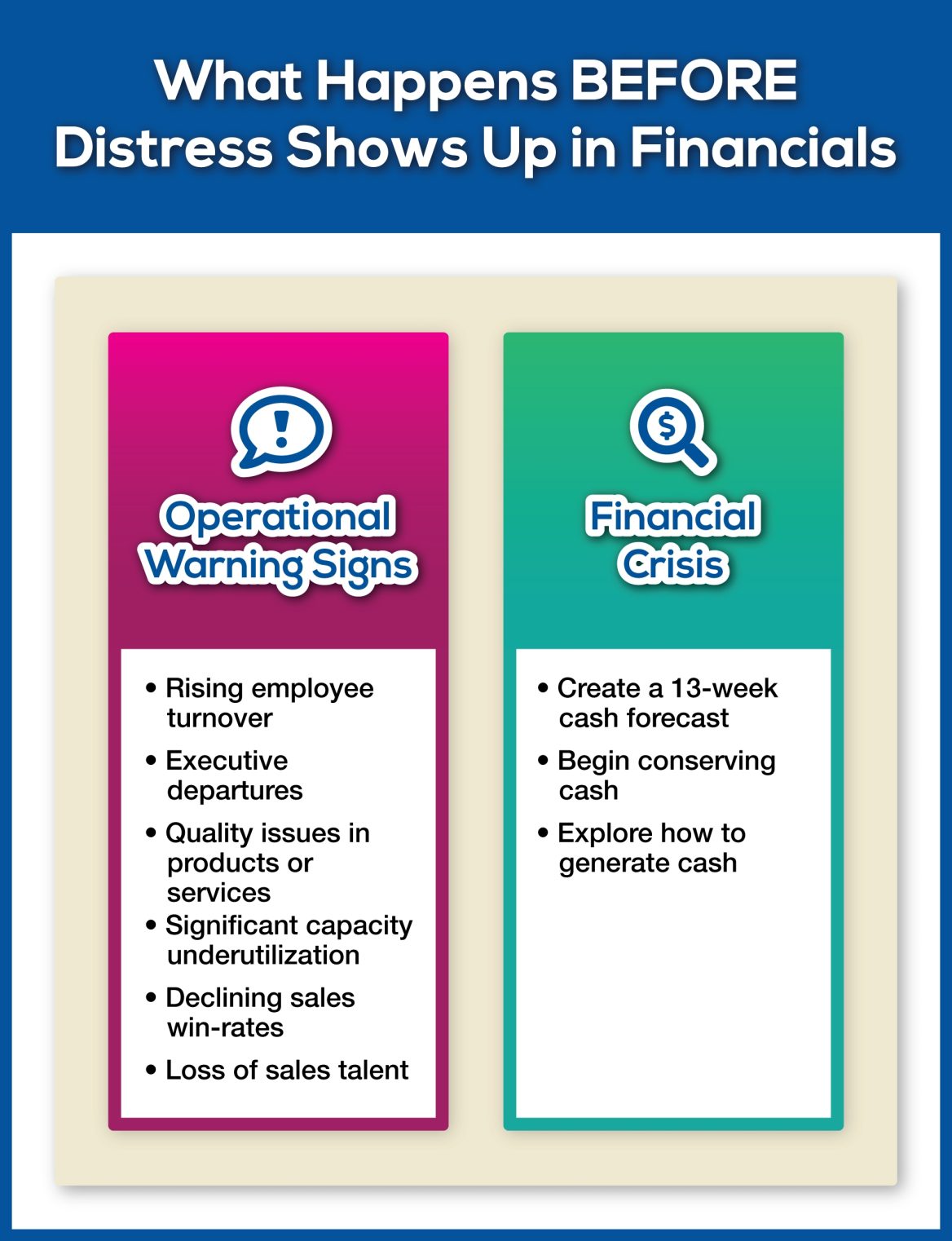
Outside of financials, watch for:

  • Rising employee turnover  
  • Executive departures  
  • Quality issues in products or services 
  •  Significant capacity underutilization  
  • Declining sales win-rates  
  • Loss of sales talent

And those operational signs can sometimes hit before the numbers really tell the full story. If your best people are leaving or your customers are starting to feel a dip in quality, that’s your early warning system right there.

Q: What happens in the first 30 days of a turnaround?

Jim:
The first 30 days are all about getting your arms around reality – and doing it quickly. Remember, “we’re not here to talk about the problem, we’re here to fix it.”

Two things must happen immediately:

  1. Assess the business – what’s broken and why
  2. Build a cash forecast – to determine runway

And those two things really happen in parallel. While we’re digging into operations, we’re also asking, “How much time do we actually have?” Because that answer dictates everything.
 

From there, you develop:

  1. A short-term stabilization plan
  2. A longer-term turnaround plan

The stabilization plan is about stopping the bleeding – preserving cash, making sure the lights stay on. Then the turnaround plan is where we step back and say, “Okay, how do we get this business back to where it needs to be – not just surviving, but actually performing again?”

Q: How much time does a company typically have once cash flow becomes tight?

Jim:  
This is one of the most important – and most misunderstood – questions I get. The honest answer is: it depends… but typically, you have less time than you think.

This is where a 13-week cash forecast becomes absolutely critical. It’s a practical tool designed to show when you may run out of cash and available credit. Now, no forecast is ever going to be 100% accurate, but that’s not really the point—it gives you visibility and, more importantly, time to act.

When you’re updating and reviewing that forecast on a weekly basis, it helps you clearly understand your runway and the window you have to make meaningful changes. From there, the focus needs to shift quickly to cash conservation and cash generation – identifying where you can preserve liquidity and where you can accelerate it.

And I’ll add one more thing: communication with your bank is key. Keeping an open and transparent dialogue can make a significant difference. If your lender understands your plan and sees that you’re being proactive, they’re often more willing to work with you and help bridge short-term gaps.

Q: What leadership mistakes do you see most often?

Jim:  
The biggest one: waiting too long to act.

There’s a tendency to hope things will turn around on their own – kind of a “let’s just give it one more quarter” mindset. I’ve seen that movie before, and it usually doesn’t end well.

Other mistakes include avoiding tough decisions, not involving the team, and failing to regularly analyze financials.

And I’ll say this too – running a business without really understanding the financials is a bit like flying a plane without instruments. You might stay in the air for a while, but eventually you’re going to run into trouble.

Q: What separates companies that successfully recover from those that don’t?

Jim: 
If I had to boil it down, it comes down to a few key behaviors – and they’re not always what people expect. They are:

  1. Actively tracking and analyzing performance on a regular basis, then taking action when things are moving in the wrong direction.
  2. Having good cash forecasts, and making critical decisions based on those forecasts, on a timely basis.
  3. Having the fortitude to make hard decisions, and then implementing the changes on a timely basis.

Q: What metrics matter most during a turnaround?

Jim:  
I tell clients all the time – cash flow is the heartbeat of the business. If the heartbeat stops, nothing else really matters. Beyond that, we look at gross margin, operational performance, and any metrics tied directly to the turnaround plan.

And one thing I often emphasize is: don’t try to track everything. Pick the handful of metrics that actually drive your business and watch them like a hawk. Simplicity and discipline go a long way here.

Q: How do you measure success in the first 30, 60, 90 days?

Jim:  
Early on, success isn’t about perfection – it’s about momentum. Ask yourself, “Are we moving in the right direction, and are we moving fast enough?”

In any turnaround, you need a clear plan backed by financial projections that align with that plan. That becomes your roadmap. From there, success is really measured by how your actual performance tracks against those projections.

If you’re hitting your numbers or trending in the right direction, that’s a strong signal the turnaround is gaining traction. But if the actual results are lagging behind what you projected, that’s your cue to dig in. You either need to take additional actions or make sure the changes you’ve already identified are being executed effectively and consistently.

Q: What role do banks play when a company is struggling?

Jim:  
During times of financial distress, banks monitor risk closely. 

At the end of the day, their job is to get their money back – preferably with interest and on time. When things start to go sideways, you’ll feel that shift pretty quickly – like maxed-out credit lines or covenant violations – they may shift you into a “special assets” or workout group. 

And when that happens, it’s usually a sign that the relationship has changed. It’s no longer about growth – it’s about risk management.

Q: What should a company do the moment they sense pressure from their bank?

Jim:  
This is one of those situations where acting quickly can make all the difference. You really don’t want to put your head in the sand and hope it resolves itself – because it typically won’t.

If you’ve been moved to the bank’s workout or special assets group, that’s usually a sign your traditional banking relationship is nearing its end, at least in its current form. At that point, you need to shift into action mode.

There are three things I’d recommend focusing on right away:

  1. Have a clear, credible turnaround plan.
    That plan should outline specific actions, who is responsible for each one, and realistic target completion dates. It’s not enough to say “we’re going to improve performance” – you need to show how you’re going to do it.
  2. Develop and actively use a 13-week cash forecast.
    This gives you visibility into what’s ahead and helps you anticipate potential cash shortfalls before they become immediate crises. It also demonstrates to your lender that you’re managing the business in a disciplined, forward-looking way.
  3. Begin exploring alternative financing options.
    If you’re no longer considered bankable, you’ll likely need to look at asset-based lenders (ABLs). They specialize in higher-risk situations and can often provide the liquidity needed to stabilize the business and buy time to execute your turnaround plan.

    At the end of the day, this is about being proactive, transparent, and decisive. The companies that handle this well are the ones that face the situation head-on and move quickly to regain control.

Q: What does it mean to be “unbankable”?

Jim:  
If a company is losing money and lacks a track record of profitability, traditional banks may not lend. 

And that can feel like the walls are closing in for a business owner – but in reality, it just means you need to look at different options.  This usually means connecting with asset-based lenders (ABLs).

Q: What advice would you give to leaders trying to avoid distress?

Jim:
Start early. 

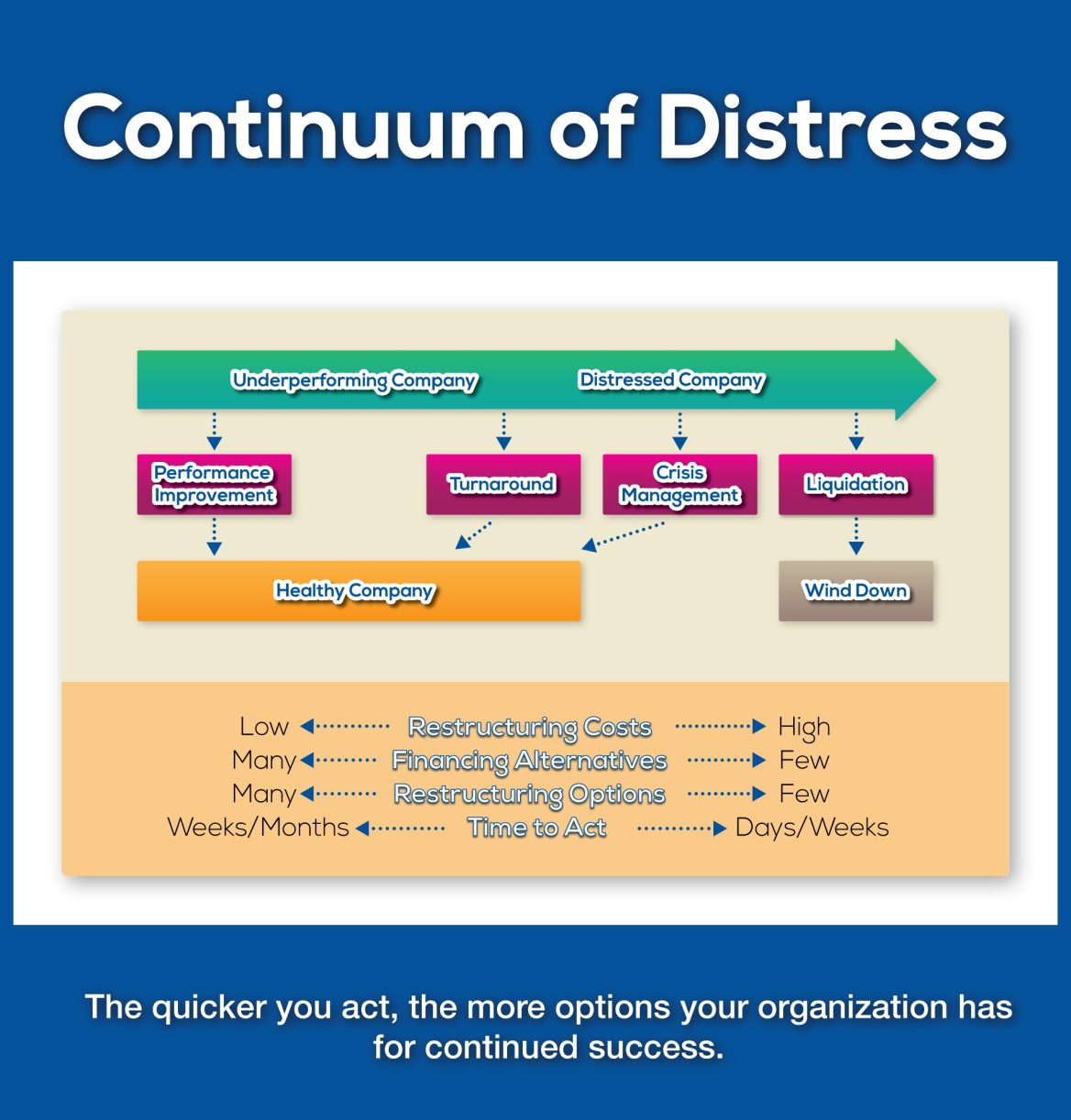
I like to remind people – it’s never too soon to raise your hand and say, “Something doesn’t feel right here.” Because once you’re in full-blown distress, your options start to shrink.

Q: What’s the #1 next step for a struggling company?

Jim:  
Get help – and get visibility into your cash. A 13-week cash forecast is a great place to start.  There is no downside to having a conversation. Even if you’re not sure how serious the situation is, getting an outside perspective can give you clarity. And sometimes clarity alone can change the trajectory of a business.

How EDSI can help

At EDSI, our team works alongside leadership teams to stabilize operations, improve cash flow, and build sustainable paths forward. Learn more about our turnaround and restructuring services on our web page detailing these services.

Case Study Alert

Want to see how restructuring and turnaround plans play out in the real world? Every turnaround situation is different – but the principles are the same. Check out this case study to see how EDSI helped a client navigate financial distress and get back on track:

Read this case study to see Turnaround in action!

Ready to talk?

If your organization is experiencing challenges – or you want to stay ahead of them—our team is here to help. Connect with us for a complimentary consultation using the form below.