Why Your CEO's Head Is the Riskiest Place for Your Succession Plan

Jill Monte - Content Specialist ·

When it comes to running a successful company, there’s no question that profit and growth are only sustainable if a clear succession plan is in place. Recent data from The Conference Board reveals the urgency: in 2025, CEO succession announcements increased significantly, driving the projected annual rate to 13% in the S&P 500, well above the 10% recorded in 2024. What good is your business if all the institutional knowledge needed to handle the ins and outs of the company is tucked away in your CEO’s head?

Without a CEO leading the company, and no-one groomed to take over the business, danger lies ahead. If you’re a business leader or owner without a succession plan, it’s time to start planning for the future. You want to keep top talent engaged and your leadership pipeline full, right? If you answered yes, then keep reading to learn how to prepare for potential changes in leadership and strengthen your business.

The Current State of Succession Planning

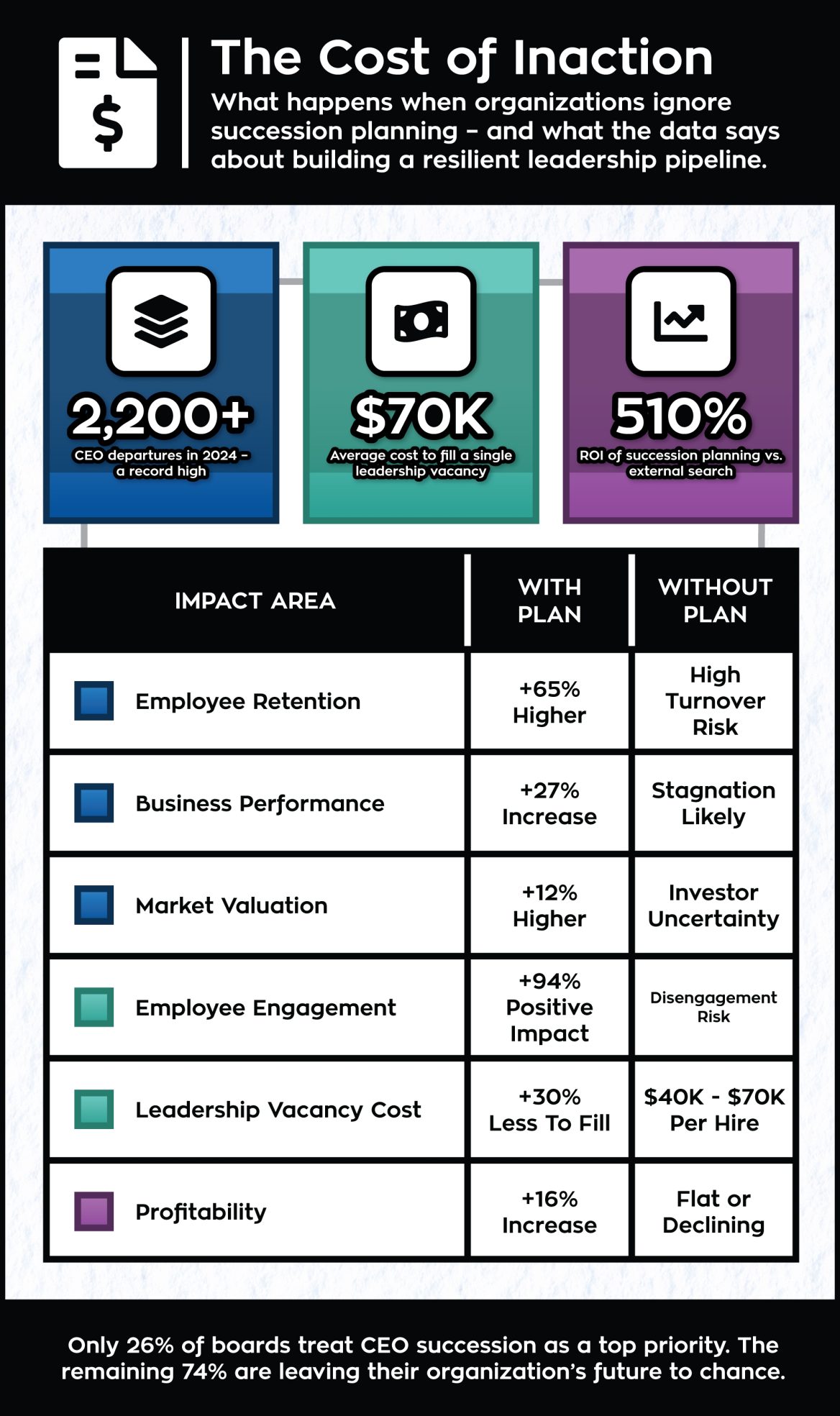
The data paints a concerning picture. According to Heidrick & Struggles’ Route to the Top 2025 research, only 26% of CEOs and board members report that CEO succession is among their top priorities and treated as such. Meanwhile, the same research reveals that 57% of CEOs and board members have relatively little confidence that their CEO succession planning process is positioning their organization well for the future.

The leadership churn is accelerating. The Conference Board reports that succession rates for CEOs aged 64 and older dropped by 8% in 2024, pointing to what experts call a “retirement cliff” on the horizon. At the same time, 64% of C-suite leaders say they are likely to make a move beyond their current employer—a 14-percentage point increase that underscores the volatility in today’s leadership landscape.

The financial implications are equally striking. Research from SIGMA Assessment Systems demonstrates that a succession plan can deliver a 510% return on investment (ROI) vs. filling a key role via an executive search firm, and up to 660% vs. filling a vacancy through a traditional hiring process, resulting in savings between $40,000 to $70,000 to fill an average leadership vacancy. Organizations that invest in their people see the returns: almost all employers (94%) said that having a succession plan positively impacts their employees’ engagement levels.

Getting Started: Your First Steps

Rather than overwhelming you with every detail of the succession planning process, we've distilled the process into key strategic actions that deliver the greatest impact.  Before moving forward, be sure to download this free succession planning workbook. It will walk you through the succession planning process outlined below.

Pre-Succession Planning Checklist

Our Pre-Succession Planning Checklist is an excellent place to start. It’s a useful resource to help you frame your tasks ahead and prepare for the first steps in the planning process. Your goal is to ultimately create a succession plan that can be easily updated and managed as time goes on and circumstances change. We’re here to help guide you each step of the way!

As you get ready to move forward, it’s also helpful to ask yourself these questions:

  • Do I understand all the different skill sets our workers have?
  • Who is likely to be leaving soon?
  • Are there employees with transferable skills?
  • Who could be trained to transition into vacated or soon-to-be vacated positions?
  • How prepared are we for unexpected leadership departures?

Step 1: Identify Critical Positions

As your first action item, identify which positions are the most critical to the success of your organization. Current trends from The Conference Board show that 77% of new CEOs in the S&P 500 in 2024 were internal hires, with the share of incoming “insider” CEOs with 20+ years of tenure-in-company at 27%, up from 18% in 2022. This data emphasizes the importance of developing internal talent. The average tenure of incoming internal CEOs is 17 years in the S&P 500, highlighting the long-term investment required in leadership development. 

 If necessary, take time to talk one-on-one with your leadership-level employees about their positions, e.g. job duties, skills and responsibilities. Position criticality is rated on a scale of 1-5 and includes factors such as degree of decision making authority and management of other critical positions. This assessment helps you understand where your organization is most vulnerable and where succession planning efforts will have the greatest impact. 

Step 2: Assess Retirement Risk

Next, it’s helpful to determine the estimated amount of time until the current employee may leave the critical position, also known as retirement risk factor. See below for a simple chart. This will give you an idea of what the future organizational structure may look like, based on possible retirements or leadership vacancies.

Step 3: Develop Success Profiles

Developing success profiles is another vital step in the process. Success profiles are position-specific and involve four main elements that foster success on the job, including: behaviors, knowledge, experience and skills. First, identify the success factors necessary for each critical position, then analyze which factors each potential successor has, and the ones they need to further develop. This information will help you determine whether or not each potential successor has the knowledge, experience, personal attributes and competencies required of a particular position. As The Conference Board research reveals, institutional knowledge is critical—the average tenure of incoming internal CEOs is 17 years, demonstrating the value of long-term organizational experience.

Step 4: Knowledge Capture and Transfer:

In succession planning, the people part is the most important aspect, but you also need to spend time on the knowledge capture and transfer process. What is that, you ask? Knowledge capture and transfer involves documenting and transferring key knowledge and information people utilize to excel at their jobs. Obviously when someone is leaving your organization, recording and transferring their knowledge becomes increasingly urgent.

Position Risk Factor Scoring Method

Position Risk Factor Scoring Method

We recommend using the following scoring method to rate the amount of risk the organization would experience if this person’s knowledge and skills were lost. Ask yourself, “what type of knowledge and skills does this employee possess?”

5 - Critical and unique knowledge/skills. Requires 3-5 years of training and experience. No ready replacements. 

4 - Critical knowledge/skills. Limited duplication at other locations, some documentation. Requires 2-4 years of focused training and experience. 

3 - Important knowledge and skills. Documentation exists. Personnel onsite possess the same knowledge/skills. Requires 1-2 years of training. 

2 - Procedural non-mission critical knowledge and skills. Up-to-date documentation exists. Current training programs in place can be completed in >1 year. 

1 - Common knowledge and skills. External hires with knowledge/skills readily available. 

Next, utilize the same scoring method as shown earlier in the Retirement Risk Factor chart. Multiply these scores to reach the total knowledge loss risk score.

Total Knowledge Loss Risk = Retirement Risk Factor × Position Risk Factor

This calculation helps prioritize which positions require immediate attention for knowledge transfer initiatives. For example, a position with a Retirement Risk Factor of 5 (retiring within 0-2 years) and a Position Risk Factor of 5 (critical and unique knowledge) would score 25—the highest priority for succession planning.


Step 5: Conduct Knowledge Loss Risk Interviews

This would also be the perfect time to complete a knowledge loss risk interview with employees in critical positions who are at risk or leaving your organization. This interview helps to identify which broad areas of knowledge an employee possesses, some of which become the topic of subsequent interviews to gather more detailed information.

Modern approaches to knowledge transfer recommend using mentorship programs, shadowing, and team-building activities to facilitate cultural integration alongside formal documentation. Organizations should also schedule regular check-ins between outgoing and incoming leaders to ensure the knowledge transfer process stays on track.

Effective Knowledge Transfer Methods

According to recent research, organizations should employ multiple knowledge transfer strategies:

  • Digital Documentation: Create comprehensive manuals, video tutorials, and searchable knowledge bases using modern collaboration platforms like Microsoft Teams or Slack

  • Mentorship Programs: Pair potential successors with current role holders for hands-on learning and relationship building

  • Job Shadowing: Allow successors to observe and participate in daily operations before formal transition

  • Regular Feedback Sessions: Establish structured check-ins to address knowledge gaps and ensure understanding

  • Communities of Practice: Create cross-functional groups where expertise can be shared across departments

Research shows that inadequate documentation is a primary barrier to knowledge transfer, and poor documentation can result in project bottlenecks, inefficiencies, and slower onboarding processes for new employees. Don’t let your organization fall into this trap. 

Step 6: Create Visual Organization Maps

As you compile your research and data, consider utilizing a visual format (think infographic, chart, grid, etc.) that captures the current organizational structure and highlights the company’s goals and vision for the future. Visual representations help stakeholders quickly understand:

  • Current leadership structure and reporting relationships

  • Identified successors for critical positions

  • Development gaps that need to be addressed

  • Timeline for anticipated transitions

  • Knowledge transfer priorities

These visual tools make it easier to communicate your succession strategy to the board, executives, and other stakeholders, ensuring everyone understands the path forward.

The Business Case: Why Succession Planning Matters

Beyond the operational benefits, succession planning delivers measurable business results. Organizations with robust succession planning processes report:

These statistics underscore a critical truth: succession planning isn’t just about filling positions—it’s about building a resilient organization that can thrive through leadership transitions.

Looking to the Future

The landscape of leadership succession continues to evolve. The Conference Board reports that in 2025, CEO succession announcements increased significantly, driving the projected annual rate to 13% in the S&P 500, well above the 10% recorded in 2024. Additionally, external hires nearly doubled—from 18% in 2024 to 33% in 2025, marking the highest level in eight years.

These trends highlight the importance of maintaining both a strong internal pipeline and the flexibility to bring in external talent when strategic transformation is needed. The most successful organizations are those that can do both—developing homegrown leaders while remaining open to fresh perspectives from outside.

Your Action Plan

Now, armed with this information on succession planning, you’re ready to take the first steps toward building a more solid and secure workforce and positioning your company for ultimate success. Remember:

  1. Start Now: Don’t wait for a crisis. Begin identifying critical positions and potential successors today

  2. Document Everything: Create comprehensive knowledge transfer processes that capture both explicit and tacit knowledge

  3. Develop Consistently: Invest in ongoing leadership development programs for high-potential employees

  4. Communicate Openly: Share succession plans appropriately with stakeholders to build confidence and engagement

  5. Review Regularly: Update your succession plan at least annually or whenever significant organizational changes occur

  6. Measure Success: Track key metrics like internal promotion rates, time-to-fill positions, and employee engagement scores

The data is clear: organizations with robust succession planning outperform those without. They experience higher employee engagement, better financial performance, reduced turnover costs, and greater organizational resilience. In today’s volatile business environment, where CEO turnover continues to accelerate, the question isn’t whether you can afford to invest in succession planning. The question is whether you can afford not to.

Learn more: * The Conference Board: CEO Succession Practices * Heidrick & Struggles: Route to the Top Research * SIGMA Assessment Systems: Why Succession Planning is Important

Download Our Free Succession Planning Templates

Are you looking for a way to find the right person to take over a position? Fill your talent pipeline? Ensure that valuable knowledge is transferred before it's lost? Or, did someone say the word, "retirement?" Our easy-to-use templates can get you started.

Download Templates

Ready to develop a comprehensive succession plan for your organization?

Contact us today to learn how our consulting services can help you build a resilient leadership pipeline and secure your company’s future.