
Bridging Education and Workforce: Career Readiness Success at Abington Junior High School
The Challenge
Are we properly preparing youth early enough to get them on the track of a career or post-secondary training that both utilizes their skills and interests and also aligns with employers and labor force needs?
The statistics paint a sobering picture: fewer than half of high school students feel ready for college or a career, and 72% of students reported being rarely or only sometimes exposed to a variety of career options in school. Yet research clearly demonstrates the value of early career readiness education: nearly 85 percent of public and private high school graduates earned at least one credit in a career and technical education (CTE) course, and CTE has statistically significant positive impacts on several high school outcomes, including students' academic achievement, high school completion, employability skills, and college readiness.
For Abington Junior High School in Pennsylvania, bridging this gap became a priority.
Why Career Readiness Matters
The importance of early career readiness programming cannot be overstated. Consider these compelling facts:
- 93% of employers term soft skills as either "very important" or "essential"
- Research from Harvard University, the Carnegie Foundation, and Stanford Research Center reported that 85% of job success is attributed to well-developed soft skills, while only 15% is due to technical expertise
- Graduates of CTE programs earn 12% more than their peers within five years of finishing school
- 86% of respondents indicate an increased emphasis on soft skills over the last 5–10 years
Without proper career readiness preparation, students face significant disadvantages. Research shows that participation in college preparation activities can significantly affect education and work attainment as soon as one year after high school. However, in high-poverty neighborhoods, schools were less likely to report doing "very good" or "excellent" in college preparation compared with their more affluent counterparts.

The EDSI Solution
EDSI's approach centered on collaborative curriculum development that would be both sustainable and effective. Our curriculum team worked closely with Abington to:
Framework Development
We began by developing content strands based on industry research and ensuring alignment to the PA Department of Education – Academic Standards for Career Education and Work. This foundation ensured that the curriculum met state requirements while addressing real-world workforce needs.
Collaborative Content Creation
Working alongside Abington's instructional staff, we leveraged their insights on content topics that would resonate most with their students. The teachers were instrumental in identifying which material fit well with grant and academic audit requirements. This collaboration resulted in a relevant, user-friendly, age-appropriate curriculum designed for three distinct grade levels: 6th, 7th, and 8th.

Four-Strand Curriculum Design
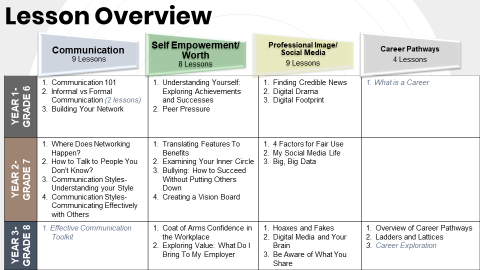
The curriculum featured four comprehensive content strands:
- Communication – Building foundational communication skills for academic and professional success
- Self-Empowerment – Fostering goal setting, attitude development, and personal growth
- Professional Image – Developing workplace-ready behaviors and presentation skills
- Career Pathways – Exploring career options, customer service, teamwork, and money management
Engaging Format
- 30 lessons delivered over a 3-year sequence
- 30-minute mini-lessons designed to fit within busy school schedules
- Gamification elements including badges for workshop completion and certificates for completing all three curriculum levels
- Spiraled approach that built upon previous knowledge year after year
- Interactive focus emphasizing discussions and student engagement
- Flexible delivery adaptable for both classroom-based and virtual/distance learning
Contextual Learning Integration
The curriculum emphasized contextual learning—a method of instruction that enables students to apply new knowledge and skills to real-life situations. By stretching the scope of instruction to include a career readiness focus, the curriculum set the stage for students to eventually enter the workforce with confidence, whether after high school or post-college.
Train-the-Trainer Excellence
A critical component of the project's success was preparing teachers to deliver the curriculum effectively. EDSI developed a comprehensive Train-the-Trainer (T3) program that included:
- A recorded webinar covering project overview, design rationale, content structure, materials location, resource access, and curriculum delivery recommendations
- Individual and small-group training sessions on delivery best practices
- Standardized lesson planning tools adapted to the "understanding by design" model
- Google Classroom and Google Drive integration for seamless document sharing and collaboration
Teachers self-selected their preferred content areas to teach, then met in workgroups to divide responsibilities and discuss content-specific delivery strategies. This approach empowered teachers while ensuring consistency across the program.
Impact and Results
Teacher Feedback
The teaching staff was overwhelmingly positive about the partnership. Between state-mandated testing, increased teaching effectiveness measures, and the challenges of virtual teaching during COVID, teachers were stretched thin. They appreciated that EDSI could "hit the ground running" to develop a standardized curriculum design that offered ease-of-use and flexibility.
Teachers found it rewarding to take a more holistic student approach with career pathways and labor market preparation as the end goals. The stand-alone career readiness curriculum allowed them to step outside their primary subject areas and engage with students in new, meaningful ways.

Administrative Perspective
Abington Junior High School Principal Daniel File reflected on the partnership:
"The curriculum development process could not have been easier. For any of the topics where we needed more information or suggestions, [EDSI] was able to provide all of the information we needed. We were especially impressed with [their] collaborative work with our team and individuals to build effective lessons. [EDSI] had a great attention to detail and was not satisfied until all of our final products were excellent. [They are] great listeners and knowledgeable partners that [were] essential to our curriculum development.
I would highly recommend EDSI as a partner for other schools, especially given the focus on college/career planning and the soft skills/social emotional learning that goes along with it. EDSI will help you reach your individual school or grade level goals."
Scaling Career Readiness: KeyWeLearn Platform
The success at Abington Junior High School demonstrates what's possible when schools partner with experienced curriculum developers. To make this type of transformative career readiness education more accessible to schools nationwide, EDSI has launched KeyWeLearn, a comprehensive digital learning platform.
KeyWeLearn provides schools and organizations with ready-to-implement career readiness curricula, interactive learning modules, and customizable content that can be adapted to meet specific institutional needs. The platform builds on proven methodologies like those used at Abington, combining:
- Evidence-based curriculum design
- Engaging, age-appropriate content
- Built-in assessment and tracking tools
- Flexible delivery options for in-person and virtual learning
- Professional development resources for educators

The Growing Need
There is a growing awareness in the K-12 and adult education arenas that career readiness is crucial and needs greater focus. Many school districts now have individualized employment plans and career development programs and are exploring deeper career readiness integration.
Abington Junior High School serves as a pioneer in this movement—an excellent example of how schools, in partnership with higher education, business, industry, and families, can align goals and resources to ensure students are prepared for the realities of post-secondary education, careers, and life.
Studies show that modern CTE programs could boost post-secondary enrollment by 20% and degree completion by 25%, yet they're still not widely implemented. The opportunity for schools to make a meaningful difference in their students' futures has never been greater.
Partner with EDSI
Is your school or organization ready to transform career readiness education? EDSI brings decades of expertise in curriculum development, instructional design, and workforce preparation to create customized solutions that meet your unique needs.
Whether you're looking to develop a comprehensive career readiness program like Abington Junior High School or explore our KeyWeLearn platform for ready-to-implement solutions, we're here to help you prepare students for success in post-secondary education and the workforce.
Contact EDSI today to learn how we can partner with your institution to build a brighter future for your students.
Whether you're ready to get started with our KeyWeLearn platform or interested in exploring custom curriculum development like we created for Abington Junior High School, EDSI is here to partner with you. Fill out the form below to connect with one of our career readiness experts.