
Evaluating Training Effectiveness: Closing the Gap Between Learning and Results
EDSI
·
Dec 08, 2025
Evaluating Training Effectiveness: Is Your Investment Paying Off?
With 39% of the global workforce expected to need reskilling by 2030, the stakes for getting training right have never been higher. Training and staff development are investments — but how can we be sure we're getting the most out of the time and money we spend? According to LinkedIn's 2025 Workplace Learning Report, organizations are spending more on learning and development than ever before, with per-employee training budgets continuing to climb as companies compete for talent and work to close growing skills gaps. For a 500-person company, even a modest per-employee training investment adds up fast. With that kind of commitment, it's critical to ensure your training programs are truly delivering results.
So, how do you measure effectiveness?
The Kirkpatrick Model: Still the Gold Standard
In 1959, Don Kirkpatrick first introduced what would become the most widely used framework for training evaluation — the Kirkpatrick Model. First presented as a series of articles and later formalized into four distinct levels, this framework has proven remarkably durable. Even as the learning and development landscape has transformed dramatically, the model remains an invaluable tool for understanding the true impact of training.
The four levels move from immediate reaction all the way through to measurable business results, allowing organizations to examine not just whether people liked the training, but whether it actually changed behavior and drove outcomes.
LEVEL 4
The extent to which targeted outcomes occur as a result of the training and reinforcement
Did you get the outcome you wanted?
LEVEL 3
The extent to which participants apply what they learned in training to their job
Are they using what they learned on the job?
LEVEL 2
The extent to which participants acquired the intended knowledge, skills, and attitudes from a training
Did they learn something new or can they do something new?
LEVEL 1
The extent to which participants react favorably to the learning event
Did they like the event?
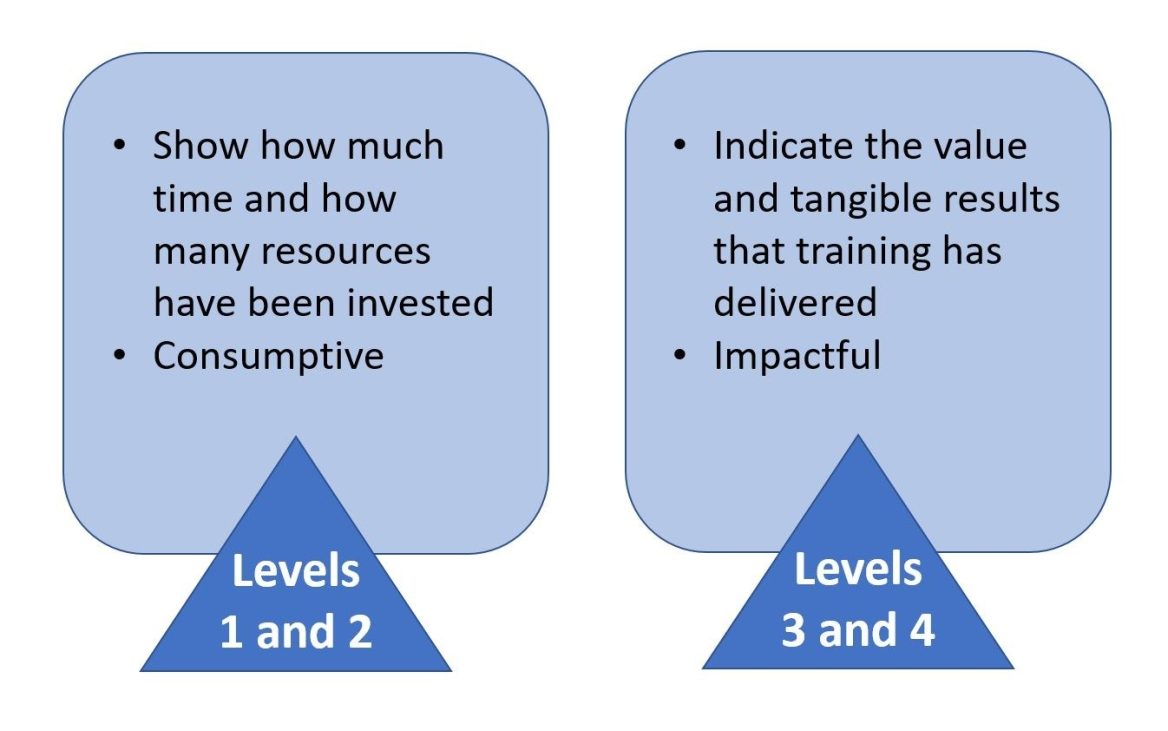
Kirkpatrick intended these levels to demonstrate the real business value and worth of training. The mistake most organizations make is thinking about these evaluation levels after a training event has already occurred. Most often, organizations evaluate Levels 1 and 2 — reaction and learning — and simply expect application and subsequent outcomes to follow naturally. This rarely happens on its own.
There is a strong correlation between Levels 1 and 2, and a strong correlation between Levels 3 and 4 — but there is no significant correlation between Levels 2 and 3. Knowing something in a training room and actually applying it on the job are two very different things.
As Sandy Almeida, MD, MPH, puts it: "Excellent training does not lead to significant transfer of learning to behavior, and subsequent results, without a good deal of deliberate and consistent reinforcement."
What This Means for Your Training Strategy
It means we need to think about each of these levels before training delivery — in fact, before we even design a training program. It is often impossible to create training value without planning for it on the front end. Here are the principles that guide effective training development:
Begin with the end in mind. What specific behavior change do you want to see, and what business outcome is it tied to? Start there, then design backward.
Determine your ROE — Return on Expectations. Before a single slide is built, align with stakeholders on what success looks like. This keeps training anchored to real organizational needs rather than activity for its own sake.
Don't just focus on the event. If you want your training investment to deliver value, rethink where you spend your time and money. Successful organizations increasingly allocate a significant portion of their training budget — often 40% or more — to post-event activities that reinforce the behaviors needed to achieve desired outcomes.
Rethinking Training Design to Maximize Value
If you want to ensure your training investment brings value, rethink where you spend your time and money in staff development. More and more often, we see successful organizations moving to a model where a minimum of 40% of training dollars are spent on post-event activities that support and reinforce the behaviors needed to achieve the desired outcomes.
Don’t be afraid to:
- propose something new
- walk away from cookie cutter trainings
- pursue customized training and coaching services
- ensure that desired outcomes specific to your organization’s needs are outlined
The Modern Learning Landscape: New Formats, Same Principles
Since 2020, the way organizations deliver training has changed significantly. The acceleration of remote and hybrid work forced a rapid shift to digital learning formats — and those formats are now firmly mainstream. Microlearning, asynchronous video, AI-powered personalization, and sophisticated Learning Management Systems (LMS) and Learning Experience Platforms (LXP) are all now standard parts of the L&D toolkit.
These shifts don't change the fundamental principles of effective training — but they do change how we apply them. Evaluating effectiveness in a self-paced digital environment requires different approaches than a traditional classroom. Engagement metrics, completion rates, and knowledge checks within a platform can inform Level 1 and Level 2 evaluation, but the Level 2-to-3 transfer gap remains just as real. The medium changes; the need for deliberate reinforcement does not.
AI Is Changing How We Measure What Matters
One of the most significant developments in training evaluation over the past few years is the growing role of artificial intelligence in measuring behavioral change and learning transfer — the hardest parts of the Kirkpatrick model to track. 80% of L&D professionals see AI as important, but only 25% use it routinely according to the 2025 LinkedIn Workplace Learning Report.
AI-powered tools can now analyze patterns in performance data, flag where behavior change is or isn't occurring, identify which employees may need additional reinforcement, and even predict learning transfer based on engagement signals. This makes Level 3 and Level 4 measurement far more accessible to organizations that previously lacked the time or resources to track them meaningfully. What once required extensive manager observation and manual data collection can now be supported by intelligent platforms that surface insights automatically.
This doesn't replace the human element of coaching and reinforcement — but it makes it easier to deploy that reinforcement where it's actually needed.
The Shift Toward Skills-Based Development
Another major evolution in the L&D field is the move away from discrete training events toward continuous, skills-based development. Organizations are increasingly building skills taxonomies — structured maps of the capabilities their workforce needs — and designing learning experiences that build those skills over time rather than in a single course or workshop.
This shift actually reinforces the core argument of the Kirkpatrick Model beautifully. When development is ongoing rather than event-driven, there are more natural opportunities to reinforce learning, observe behavior change, and connect development activity to business outcomes. The "don't just focus on the event" principle isn't just good evaluation advice — it's becoming the architecture of how leading organizations think about learning altogether.
Putting It All Together
If you want to ensure your training investment delivers real value, the path forward looks like this: plan for evaluation before you design, align on expectations with stakeholders upfront, invest in post-event reinforcement, leverage digital tools and AI to track transfer more efficiently, and think of development as a continuous journey rather than a series of isolated events.
The Kirkpatrick Model has guided effective training evaluation for over 60 years. The organizations getting the most out of it today are the ones using it not just as a measurement tool after the fact, but as a design framework from the very beginning — and pairing it with the modern tools now available to make measurement more actionable than ever.
Get the FREE Training Needs Analysis Guide
Conducting a training needs analysis is a critical step in developing a training program- it helps you truly understand the development needs of your staff and ensures your design is grounded in real organizational gaps. Download this guide now to maximize the impact of your training efforts!
DOWNLOAD NOWInterested in speaking with a member of our Innovative Learning Solutions Team?
Fill out the form below and one of our experts will be in touch asap.