
From Job Tasks to Workforce Solutions: How Job Task Analysis Connects Employer Needs, Skills and Training
EDSI
·
Sep 21, 2026
What if the key to building a stronger workforce isn't simply identifying which jobs are in demand – but understanding exactly what people need to know and be able to do to succeed in those jobs?
For employers, workforce development boards, state and local workforce agencies, education providers and economic development organizations, that distinction matters.
Today's workforce is changing rapidly. According to the World Economic Forum's Future of Jobs Report 2025, employers expect 39% of workers' core skills to change by 2030, while 63% of employers identify skills gaps as a major barrier to business transformation.
That creates an important challenge for workforce systems:
How do we make sure the training, education and workforce services available today actually reflect what employers need tomorrow?
One foundational tool is Job Task Analysis (JTA).
What Is Job Task Analysis?
Job Task Analysis is a structured, data-driven process used to identify the specific work requirements of a job – including the tasks, responsibilities, knowledge, skills and abilities required for successful performance. A strong JTA draws on input from people who understand the work, typically including experienced employees and subject matter experts, to define, validate and prioritize those requirements.
Unlike an evaluation of an individual employee, a JTA evaluates the job itself. It creates a detailed picture of what the work actually involves and what someone needs to know and be able to do to perform it effectively. Depending on the purpose of the analysis, tasks can also be evaluated against factors such as importance, frequency, safety criticality, or complexity, helping organizations identify where training and workforce attention should be concentrated.
That information can become much more than a better job description.
A well-developed JTA can serve as a foundation for:
- Identifying employer skill needs
- Developing or updating job descriptions
- Identifying workforce skill gaps
- Designing targeted training
- Aligning education and training curricula with employer needs
- Developing career pathways
- Improving job matching
- Supporting work-based learning and on-the-job training
- Informing workforce strategies at the organizational, regional or state level
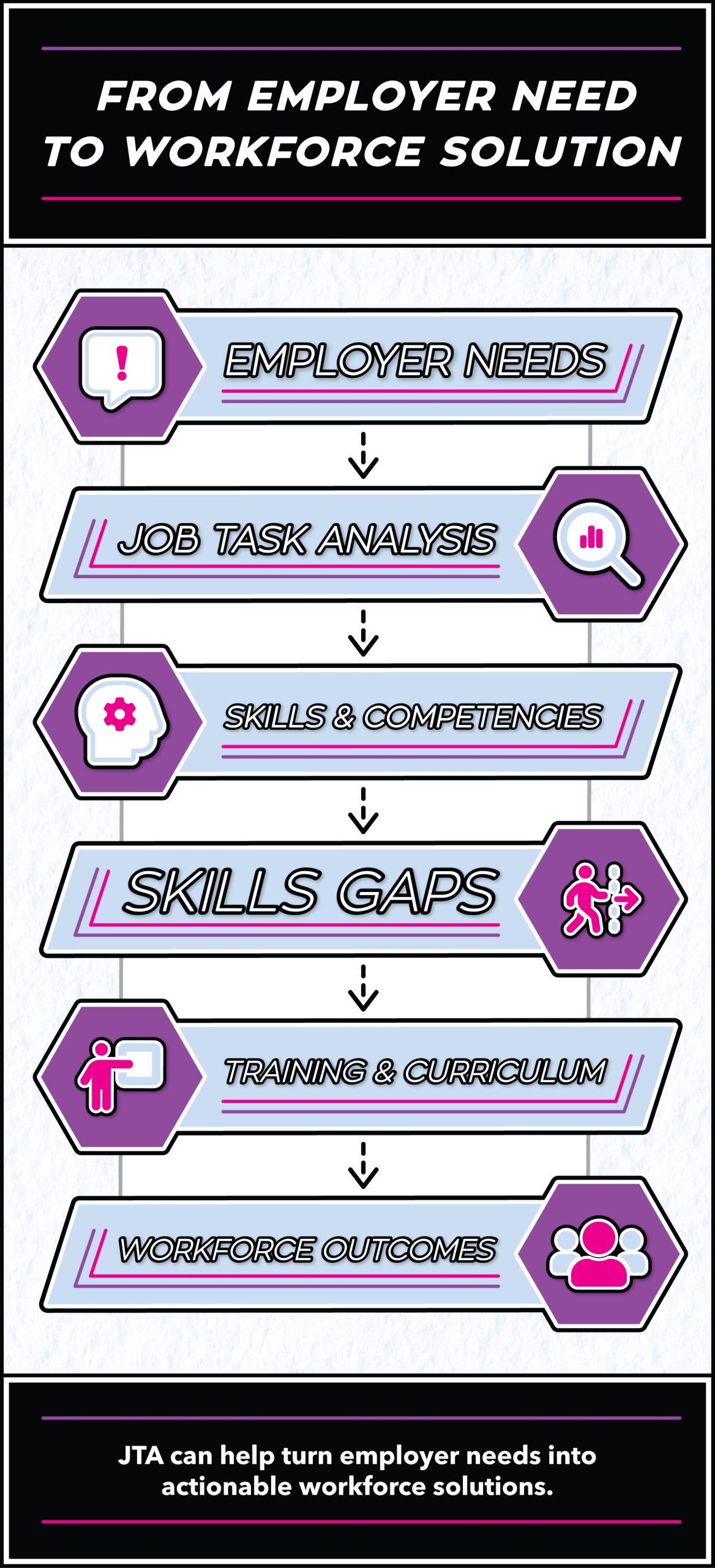
In other words, JTA creates a task-level foundation for connecting what employers need people to do with the knowledge, skills, training and workforce solutions required to support successful performance.
Why JTA Matters in Today's Workforce
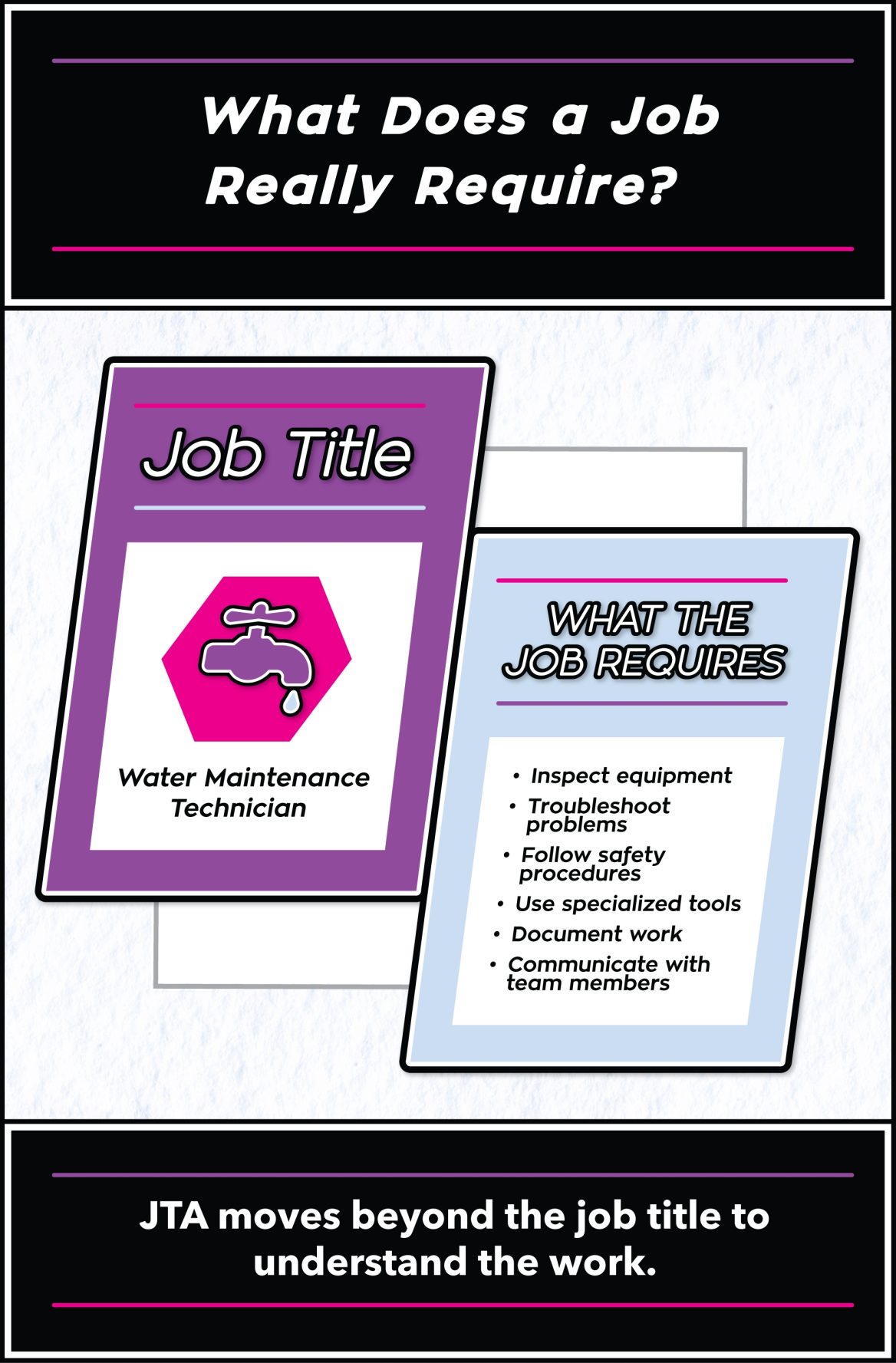
Job titles can tell us what a position is called. They don't always tell us what someone actually needs to do to succeed in that role.
That distinction is becoming increasingly important as technology, automation, artificial intelligence and changing business practices reshape jobs.
The World Economic Forum reports that AI and big data, networks and cybersecurity, and technological literacy are among the fastest-growing skills through 2030, while human skills such as creative thinking, resilience, flexibility and agility are also increasing in importance.
For workforce development leaders, this reinforces an important principle:
Before we can effectively train people for a job, we need to understand the job itself.
That's where JTA comes in. By translating a job into clearly defined tasks and the knowledge and skills required to perform them, JTA creates a common reference point that employers, educators and workforce organizations can use to align training, assess skill gaps and build other workforce solutions.
From Employer Demand to Workforce Strategy
For workforce development organizations, JTA creates a common language for connecting employer requirements with, education, training and workforce services.
Instead of starting with an existing program and asking whether it fits the job, organizations can start with the work itself: What tasks must be performed? What knowledge and skills do those tasks require? From there, they can evaluate how well existing training, workforce programs and talent pipelines align with those requirements.
“A good JTA gets underneath the job title and the job description to identify the work that actually has to be performed and the knowledge and skills required to perform it well. Once you have that foundation, you have a common language for making much more disciplined decisions about training, skill gaps, career progression and job matching.”
That shift helps workforce partners answer important questions:
- What tasks are employers struggling to find qualified candidates to perform?
- What knowledge and skills are required to perform those tasks successfully?
- Are current training programs developing those capabilities?
- Where are the most significant gaps?
- Which skills can be developed through classroom instruction?
- Which are best learned through hands-on or work-based training?
- What skills are transferable across employers or occupations?
- How can training programs evolve as jobs change?
Beyond the Job Description: What Can JTA Make Possible?
A JTA can provide the detailed, employer-informed information needed to make better decisions across the workforce ecosystem.
Align Training With Actual Employer Needs
Training programs are most valuable when they prepare people for the work they will actually perform.
JTA findings give employers and workforce partners a basis for evaluating whether existing curricula reflect current job requirements and identifying where training may need to be updated.
This can be particularly valuable for workforce development boards and training providers investing in programs designed to meet local employer demand.
EDSI's Workforce Skill Gap Analysis builds on task-based job profiles to compare the skills required for a job with current workforce capabilities and identify priority gaps.
Strengthen Skills-Based Career Pathways
Understanding the tasks, knowledge and skills associated with a job allows organizations to look beyond individual occupations.
When common and transferable skills across multiple jobs are understood, workforce partners can begin to identify connections between occupations and potential career pathways. Those connections can give jobseekers a clearer view of not just where they can get a job today, but where their skills could take them next.
Improve Job Matching
Traditional job matching often starts with job titles, resumes and basic qualifications.
A more detailed understanding of the work provides a richer picture of what employers actually need and what jobseekers can offer.
EDSI's Job Matching powered by Skilldex® uses task-based job profiles to evaluate skills, responsibilities and tasks, helping create stronger connections between people and opportunities.
Support Work-Based Learning and Training
JTA provides workforce organizations and employers with the information needed to develop training that reflects the actual workplace.
Rather than building a training plan around a generic occupation, organizations can use employer-informed job requirements to identify the skills and competencies that should be developed through classroom learning, hands-on training, on-the-job training or other work-based experiences, as depicted in the graphic below.
How EDSI Uses JTA to Connect the Dots
At EDSI, Job Task Analysis is often a starting point for a broader workforce or training strategy. The goal isn't simply to document job duties. It's to use a detailed understanding of the work to inform decisions about skills, training, curriculum and career development.
EDSI's approach moves from a broad understanding of an occupation to a more detailed picture of the tasks performed and the knowledge, skills and other requirements needed for successful performance. That information can then be used to evaluate existing training, identify gaps, develop curriculum, inform career pathways and support other workforce solutions.
JTA in Action: From Job Tasks to Training
EDSI's work with the City of Tucson Water Department demonstrates how JTA can serve as a foundation for broader workforce and training improvements.
Tucson wanted to evaluate and update its existing training and develop a customized, skill-based curriculum for employees in its Water Maintenance and Customer Service divisions. EDSI began with an industry benchmarking study and Job Task Analysis to understand the skills required to perform the work.
The JTA then became the foundation for evaluating the relevance of existing training, identifying gaps and comparing Tucson's practices with those of peer utilities.
The findings ultimately informed curriculum maps, training priorities, skill documentation and mentoring components. For the Meter Service team, the work supported a new three-year training program with clear task and skill requirements for progression from Level 1 to Level 3.
“The job task analysis, which details the actual job tasks performed, becomes the common language that allows for an apples-to-apples comparison,” explains Brian Lester, EDSI Consulting Director.
The takeaway? JTA doesn't have to be the end product. It can be the foundation for building training and workforce systems around the realities of the work.
Why This Matters to Workforce Development Boards and Regional Partners
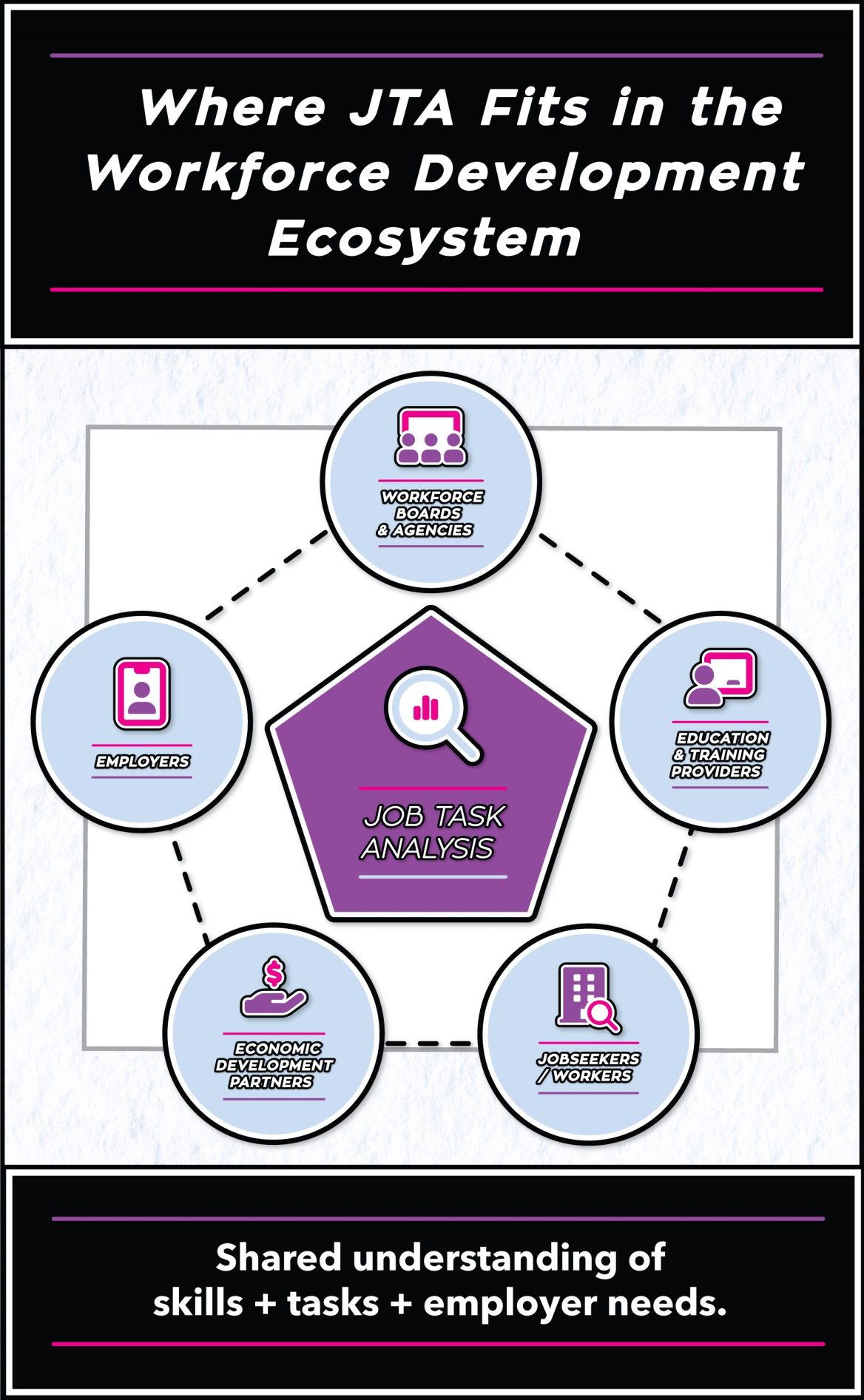
At a regional level, JTA can extend beyond a single employer to help workforce partners identify common skill needs, training gaps and opportunities for greater alignment.
Workforce Development Boards, state and local agencies, community colleges, training providers and economic development organizations can use employer-informed job and skills data to identify where their systems are aligned – and where they aren't.
That helps answer questions such as:
- Are training programs and credentials aligned with current employer requirements?
- Where are the most significant regional training and skill gaps?
- Which skills are common across employers and occupations?
- Where could employers collaborate with education and training providers?
- Which occupations and transferable skills could support stronger career pathways?
How can workforce investments better respond to changing employer demand?
EDSI's Regional Skills Alignment service specifically connects JTA and skills-gap analysis with employer needs and the evaluation of regional training offerings.
The Bigger Picture: Building More Responsive Workforce Systems
From Job Tasks to Workforce Solutions
A strong Job Task Analysis turns detailed information about work into a practical foundation for workforce decisions. By connecting job requirements with training, career pathways and other workforce solutions, JTA helps organizations move from understanding employer needs to acting on them. The goal isn't simply to understand a job. It's to use that understanding to build a better workforce.
EDSI partners with employers, workforce development boards, government agencies, education providers and regional organizations to understand workforce needs and develop solutions that connect people, skills and opportunity.
Want a deeper look at the JTA process?
Our 7-Step Job Task Analysis Guide walks through the practical steps of conducting an effective JTA – from identifying subject matter experts to defining tasks and validating the results.