
What It Really Takes to Lead: Engaging Employees and Building a Team That Stays
Christina Dusenberry
- Regional Director
·
Feb 10, 2025
Business leaders and executives have different experiences and points of view on what it takes to be an effective leader. But here's what I've learned after years of leading teams: the leaders employees remember — and stay for — are the ones who show up for them as human beings first. For me, the foundation of a trusted leader starts with being approachable, available and authentic. Living out those traits means taking the time to get to know employees on a personal level while empowering the team to succeed together. Great leaders have the ability to guide their team toward a well-defined vision by putting into practice these principles:
Communicate clearly and often
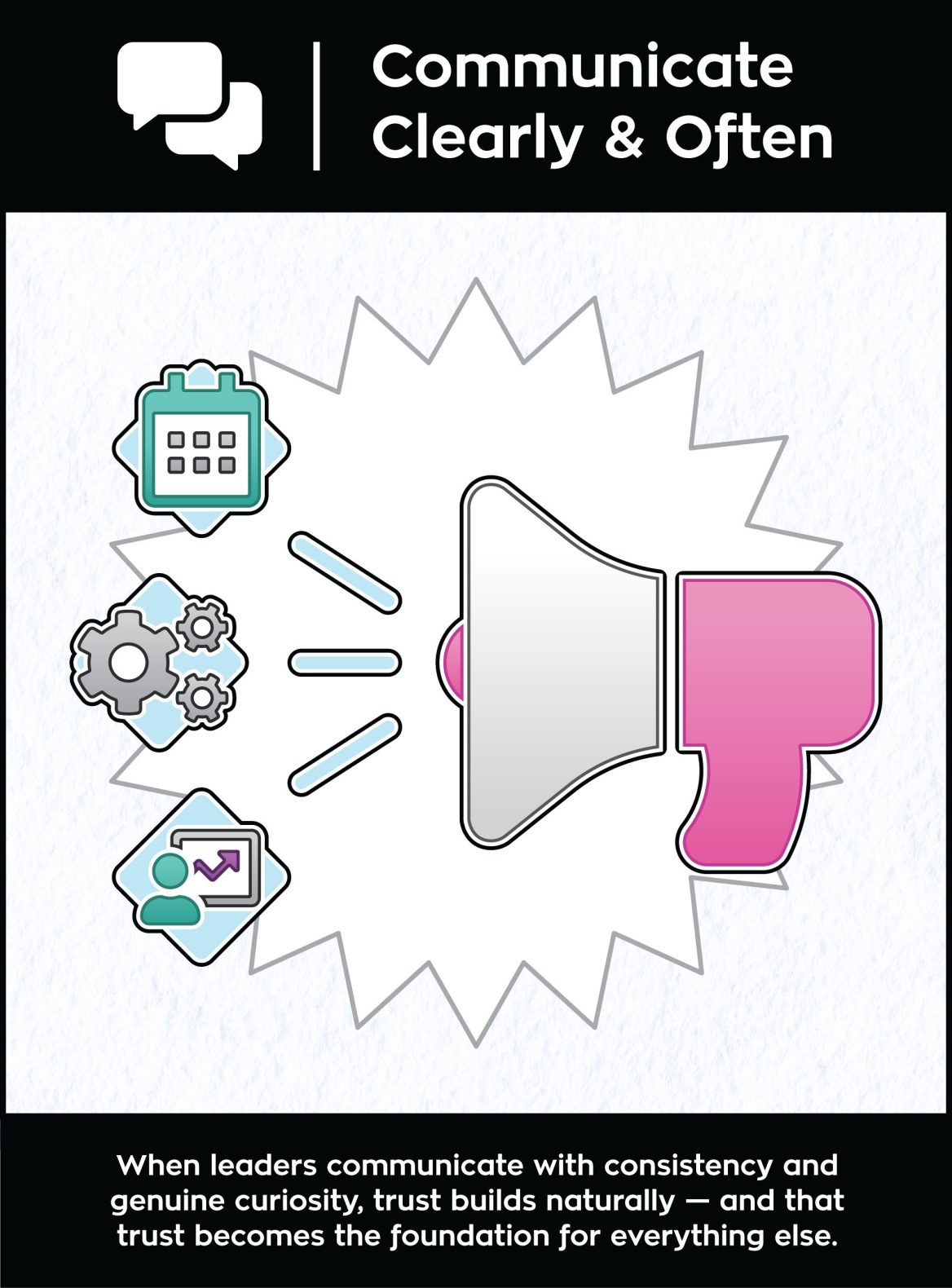
Force-feeding the communication process to your employees might sound a bit extreme, though for me, it’s an essential way to develop and sustain connections with my team. On a regular basis, I meet with members of my team both individually and in group settings. It helps me stay informed while also encouraging communication amongst our leadership team. Most importantly, intentional communication helps me learn what my employees have going on, because our personal lives don’t stop during business hours. When leaders communicate with consistency and genuine curiosity, trust builds naturally — and that trust becomes the foundation for everything else.
Cultivate a personal connection
I’ve always believed in a “people first, employees second” philosophy. With my team, I’ve seen firsthand the positive shift in employees’ attitudes and commitment once they realize that I’m looking out for their best interests, not only as their manager, but as their mentor and friend. That means that I set aside time on a regular basis to listen to what each of my team members have going on – both professionally AND personally. This isn't about prying — it's about genuinely caring. And employees can tell the difference.
Be a mentor
The best success stories have happened when I’ve been able to mentor an employee and get to know their strengths and passions, and then brainstorm with them over a period of time to explore possible new projects or career paths. Some of the most rewarding moments in my career have been when I have supported one of my team members to connect the dots and reach their goals, or they end up finding fulfillment through a new opportunity within our organization. Mentorship isn't a formal program — it's a mindset. It's choosing to invest in someone's future, not just their current job performance.
Drive engagement and retention
Doing work we’re good at drives engagement, and engagement drives retention. In order to understand what we are good at, we first must identify our strengths. Helping employees identify skills needed for the future and considering multiple pathways to grow those skills enhances the employee’s career options. This also drives engagement and retention. As a result, productivity, morale and involvement are increased, which contributes to employee retention. As a result, productivity, morale and involvement are increased, which contributes to employee retention.
One of the ways we support this at EDSI is through our proprietary Skilldex® software system — a tool we developed specifically to help leaders and employees get clear on role-specific knowledge, responsibilities and tasks by measuring pre-established competency levels. It came out of a real need we saw: employees and managers often aren't aligned on what "great" looks like in a given role. Skilldex® helps bridge that gap.
For more information on Skilldex®, click here.
When employees know their expectations and have the tools they need to meet and exceed those expectations, we set them up for success. In turn, we keep them engaged and committed to personal, professional and company goals. This results in great talent wanting to stay and grow with the company. This is how great leaders lengthen the tenure of their very best employees.
Engage and retain: 6 tactics
When it comes to engaging and retaining valuable team members, try embracing these six tactics to create a positive working environment that will keep staff morale high and turnover low. These will greatly contribute to creating stronger relationships, improved communication, better work efficiency, more job satisfaction and ultimately, your company’s success.
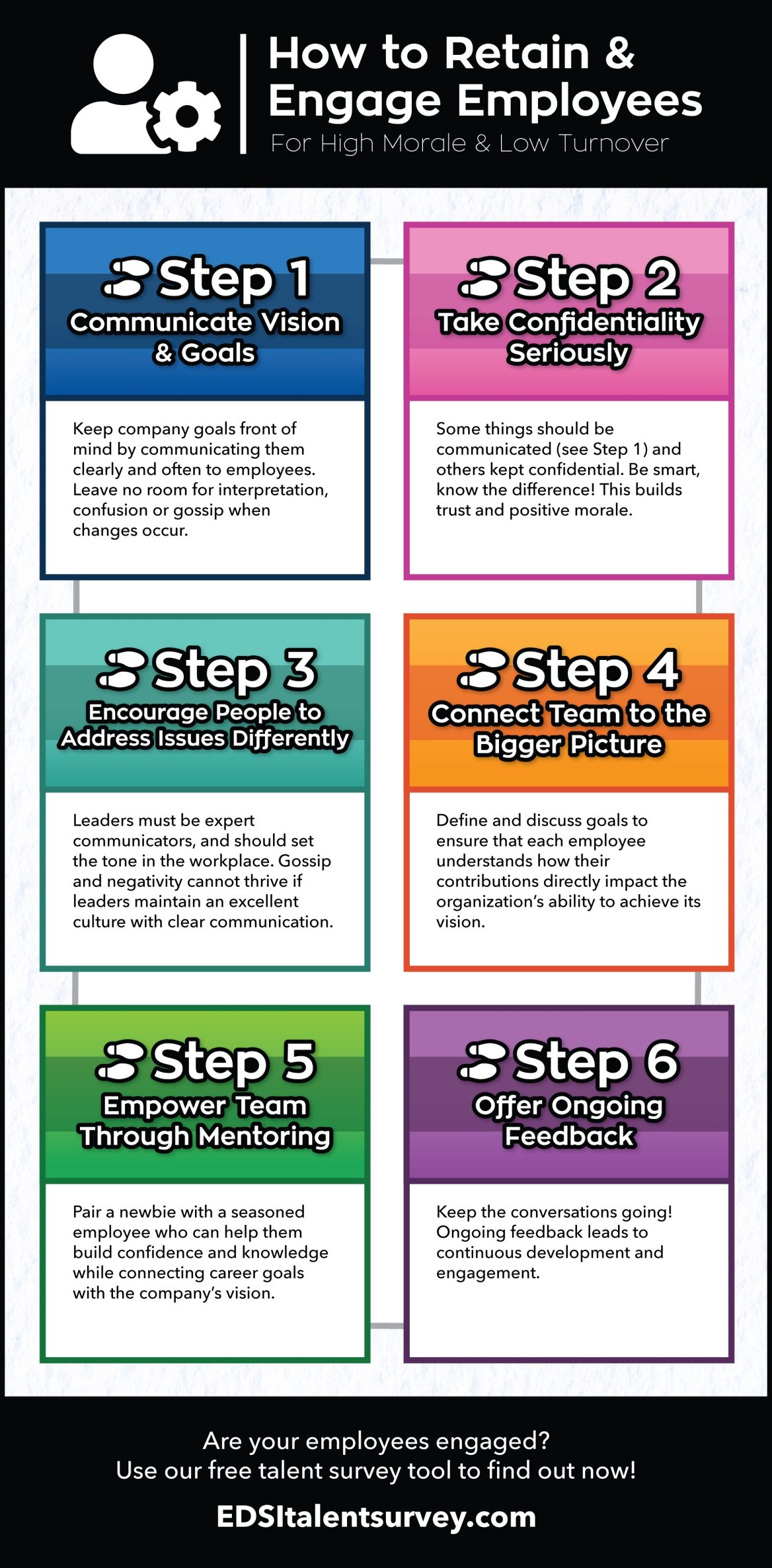
How to retain and engage employees for high morale and low turnover
Step 1: Communicate. Keep company goals front of mind by communicating them clearly and often to employees.
Step 2: Take confidentiality seriously. Some things should be communicated, and others kept confidential. Know the difference!
Step 3: Encourage people to address issues differently. Define and discuss goals to ensure that each employee understands how their contributions directly impact the organization's ability to achieve its vision.
Step 4: Connect the team to the bigger picture. Define and discuss goals to ensure that each employee understands how their contributions directly impact the organization's ability to achieve its vision.
Step 5: Empower the team through mentoring. Pair a newbie with a seasoned employee who can help them build confidence and knowledge while connecting career goals with the company's vision.
Step 6: Offer ongoing feedback. Keep the conversations going! Ongoing feedback leads to continuous growth, development and engagement.
Be flexible
By building rapport with employees on a personal level and using that knowledge to guide the work being done every day on the job, we make employees feel part of the team and more connected to the company. If I can lend an ear while an employee vents about a struggle happening in their life, I’m glad to do it. I may even be able to lessen or reorganize their workload to allow some needed breathing room while they work through an issue at home.
One situation that has stayed with me occurred when I noticed one of my team members struggling after she returned from maternity leave. She was having trouble keeping her head above water, a task that she previously took in stride. After many months of conversations and insight into her personal life, I took some initiative and started to investigate other opportunities that would possibly be a better fit for her. I ended up presenting her with a lateral move opportunity in another office that was much closer to her home, which reduced her commute time and lowered her stress level. Although it provided somewhat of a logistical strain for me to implement, it was worth it because it created the ideal work-life balance solution for her. As a servant leader, I believe her confidence and wellbeing — as a professional and as a mother — mattered just as much as her output.
This kind of intentional, personalized support is actually at the heart of our Career Sculpting program at EDSI — an approach we developed to help organizations retain talent by shaping roles and opportunities around the whole person, not just a job description. For more information on Career Sculpting, click here: https://www.edsisolutions.com/blog/view/why-your-company-should-invest-in-career-sculpting.
By taking the extra step to anticipate my team member’s needs in that situation, she avoided getting burned out or resigning, and the level of trust and respect between us increased. The end result was a valuable employee being retained and reenergized. A win-win.
Being flexible and open minded to change allows you to not only think outside of the proverbial box, it allows you to get rid of the box altogether. An organizational chart needs to be fluid not only for change in our business, it needs to change for our talent as well. In today's workplace, where employees have more options than ever, flexibility isn't a perk. It's a retention strategy.
You may have heard the saying "people don't leave companies, they leave managers." I take that seriously. My goal is to be the kind of leader that makes leaving unthinkable — not through obligation, but through genuine investment in each person on my team.
Ready to build a more engaged, resilient team?
EDSI works with organizations to develop the leadership practices, tools, and programs that make great cultures possible. Fill out the form below to connect with us.