How EDSI’s Innovative Learnings Solutions Team Approaches Risk Mitigation in Instructional Design and Learning Projects

Kim Glenn - Managing Director, Innovative Learning Solutions ·

Risk Isn’t What Happens. It’s How You Prepare.

The most successful learning initiatives aren’t defined by how smoothly they begin, but by how well they are prepared to navigate complexity. At EDSI, our Innovative Learning Solutions team has spent decades designing and delivering workforce development programs, adult education initiatives, and large-scale learning projects across the country — and we’ve seen firsthand that thoughtful preparation is what turns strong ideas into meaningful, lasting impact.

What distinguishes successful projects is not whether challenges arise, but whether teams are prepared to respond when they do. At EDSI, we often summarize this mindset through three simple values: Show Up, Smile, and Support. In complex projects, showing up prepared, maintaining a solutions-focused mindset, and supporting one another through challenges are not just cultural ideals—they are practical strategies for navigating risk and delivering results.

We believe that that strong preparation supports innovation — it enables it. When teams understand how they will respond to uncertainty, they are freer to design boldly, experiment thoughtfully, and focus on outcomes rather than fear of failure.

Over time, this insight evolved into a discipline for our team. Today it shapes the risk mitigation framework we use to guide learning initiatives from early planning through evaluation and continuous improvement.

We Start with a Pre-Mortem, Not an Assumption

Many projects begin by planning for success. We begin by asking a different question:

“If this project failed, what would have caused it?”

This exercise (known as a pre-mortem) was popularized by psychologist Gary Klein and has been shown to improve decision-making by encouraging teams to identify potential problems before they occur (Klein, 2007).

Before development begins on any instructional initiative (whether it’s a statewide conference, an eLearning series, a facilitated training program, or a technical assistance effort) our team runs a structured pre-mortem conversation. It surfaces risks that optimistic planning often overlooks: scope alignment, stakeholder expectations, technology constraints, learner context, and whether the learning design is positioned to produce the outcomes we promise.

Conducting a pre-mortem requires teams to show up fully engaged in the work—prepared to ask difficult questions, challenge assumptions, and anticipate obstacles before they affect learners or stakeholders.

The insights from that conversation feed directly into our Risk Mitigation Worksheet, a structured planning tool we use throughout the project lifecycle. It captures:

• Risk category (scope, timeline, stakeholder alignment, instructional quality, technology, evaluation, and change management)
• Likelihood and impact ratings
• Early warning indicators — subtle signals that a risk may be emerging
• Prevention strategies and contingency plans
• A clearly assigned risk owner
• Escalation and communication pathways


One principle in this framework is non-negotiable: every risk must have an owner. Clear ownership ensures clarity, accountability, and timely action.

Risk Lives Across the Whole Project Lifecycle

A common mistake in project management is treating risk assessment as a one-time event at kickoff. In reality, conditions evolve as projects progress.

Our framework intentionally spans the full lifecycle of a learning initiative.

Phase 1: Analyze & Design — Anticipate Early

The most powerful risk mitigation happens before development even begins.

During analysis and design, we run what we call a backwards risk check:
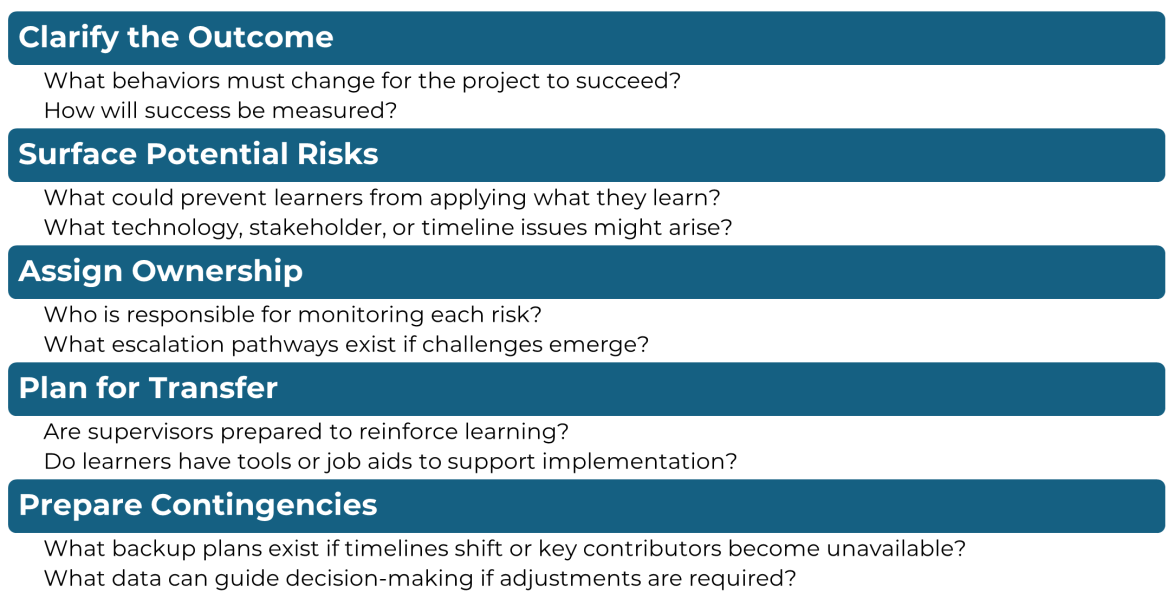
What on-the-job behaviors must change for this project to succeed? What conditions might prevent learners from applying what they learn? What data will demonstrate that the effort worked — and what might prevent us from accessing that data?

This approach draws on backwards design principles (Wiggins & McTighe, 2005) and evaluation frameworks such as the Kirkpatrick Model (Kirkpatrick & Kirkpatrick, 2006) and Thalheimer’s Learning Transfer Evaluation Model (LTEM) (Thalheimer, 2018).

Grounding risk analysis in these frameworks ensures we’re not just asking “What could go wrong?” but also “What could prevent learning from turning into real behavior change?”

Phase 2: Develop & Implement — Monitor Continuously

Risk rarely remains static once development begins. Scope expands. Stakeholder feedback shifts priorities. Technology compatibility issues surface in testing. Content overload creeps into the design.

For this reason, we treat risk monitoring as an ongoing activity during every project checkpoint or sprint review. Teams reassess likelihood and impact, document decisions made in response to emerging risks, and revisit what we call a transfer-of-learning risk check — ensuring the supports learners need to apply new skills actually exist.

Research consistently shows that without intentional transfer strategies, most training fails to translate into workplace behavior change (Baldwin & Ford, 1988; Burke & Hutchins, 2007). Monitoring those conditions during implementation helps prevent learning initiatives from stopping at the classroom door.

Ongoing risk monitoring also reflects a commitment to supporting the team and the client throughout the project lifecycle. By surfacing risks early and addressing them collaboratively, teams create an environment where problems are solved together rather than left for individuals to manage alone.

Phase 3: Evaluate & Close — Capture and Transfer Learning

The end of a project is also the beginning of the next one.

At closeout, we conduct a final risk review to identify which risks were successfully mitigated, which emerged unexpectedly, and what lessons should shape future work.

Those lessons inform adjustments to our templates, scoping assumptions, and evaluation strategies.

Continuous improvement ensures each project benefits from the experience of the last.

Three Early Warning Signs of Risk in Learning Projects

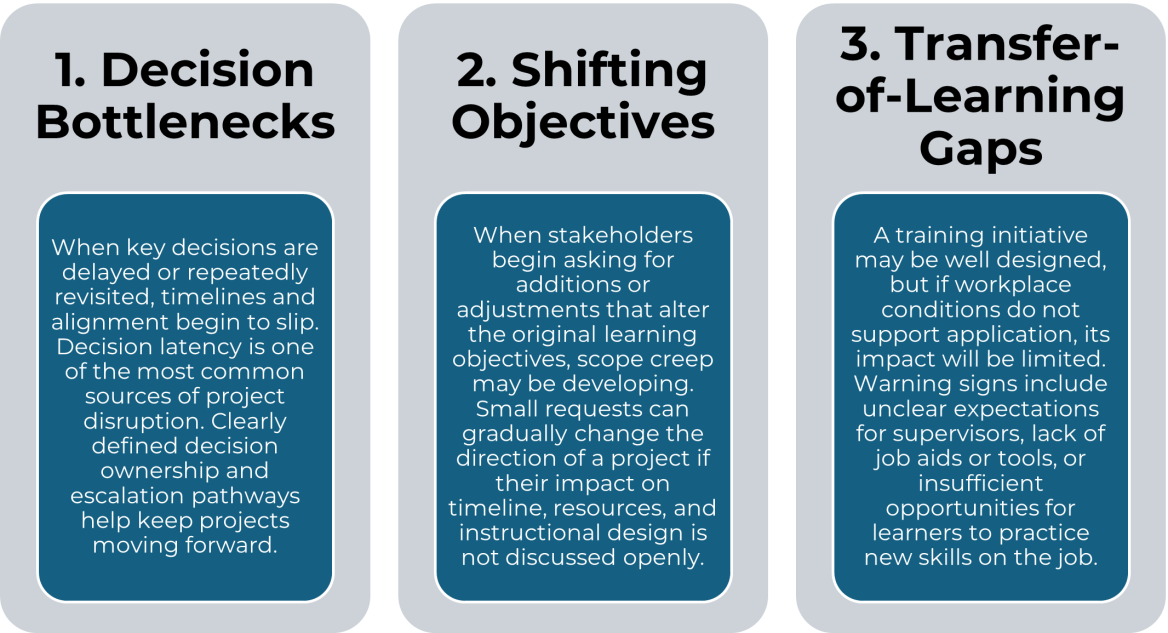
Even well-designed projects can encounter challenges. Over time, our team has noticed that many disruptions start with subtle signals. Paying attention to these early indicators allows teams to respond before small issues grow into larger problems.
3 Risk Warning Signs
When teams recognize these signals early, they can make adjustments that keep learning initiatives aligned with their intended outcomes.

Key Areas We Monitor Closely

After nearly 30 years of projects spanning workforce development systems, adult education programs, and community initiatives, several risk patterns appear consistently.

1. Decision Clarity

It’s rarely disruption itself that causes the greatest damage — it’s hesitation.
A scope issue escalates because no one has clear authority to act. Stakeholder misalignment grows because decision pathways were never defined.

Our framework explicitly maps decision ownership and escalation pathways for each risk category so teams know who is responsible for action when needed.

2. Scope Alignment

Scope adjustments can occur gradually. More often, it appears through small additions, “just one more” requests, or stakeholder feedback that subtly shifts learning objectives.

When that happens, we treat the change as a risk event, documenting the decision and its impact on timeline, budget, and instructional quality. Clear decision pathways ensure that leaders can show up when their judgment is needed, allowing teams to move forward confidently rather than waiting for direction.
 

3. Transfer of Learning Barriers

Even the most thoughtfully designed learning experience can fail if the workplace conditions for applying new skills are missing.

Research on training transfer consistently highlights the role of manager support, job aids, accountability structures, and opportunities for practice in determining whether learning leads to behavioral change (Burke & Hutchins, 2007).

For that reason, we explicitly risk-assess the conditions for transfer:

• Are supervisors prepared to reinforce new behaviors?
• Do learners have tools to support implementation?
• Is there accountability built into the system?
Kirkpatrick Levels 3 and 4 — behavior change and results — do not happen by accident. They must be intentionally designed and protected.

4. Partnership Clarity and Quality Standards

Another lesson learned over time involves vendor partnerships.

Risk is not simply about reliability — it is also about clarity and accountability. When work is outsourced without transparency around roles and quality standards, responsibility becomes unclear and quality control becomes difficult.

Today we ask three straightforward questions at the start of any external partnership:

• Is this work being handled in-house or by a subcontractor?
• Who is responsible for quality control?
• What is the remediation plan if standards are not met?
Embedding these questions early reduces uncertainty later.

Psychological Safety Is a Risk Management Strategy

Even the most well-designed risk framework depends on the culture in which it operates.

Over the years, we’ve seen projects struggle not because risks were invisible, but because team members didn’t feel safe raising concerns.

Harvard researcher Amy Edmondson’s work on psychological safety helps explain why this matters.

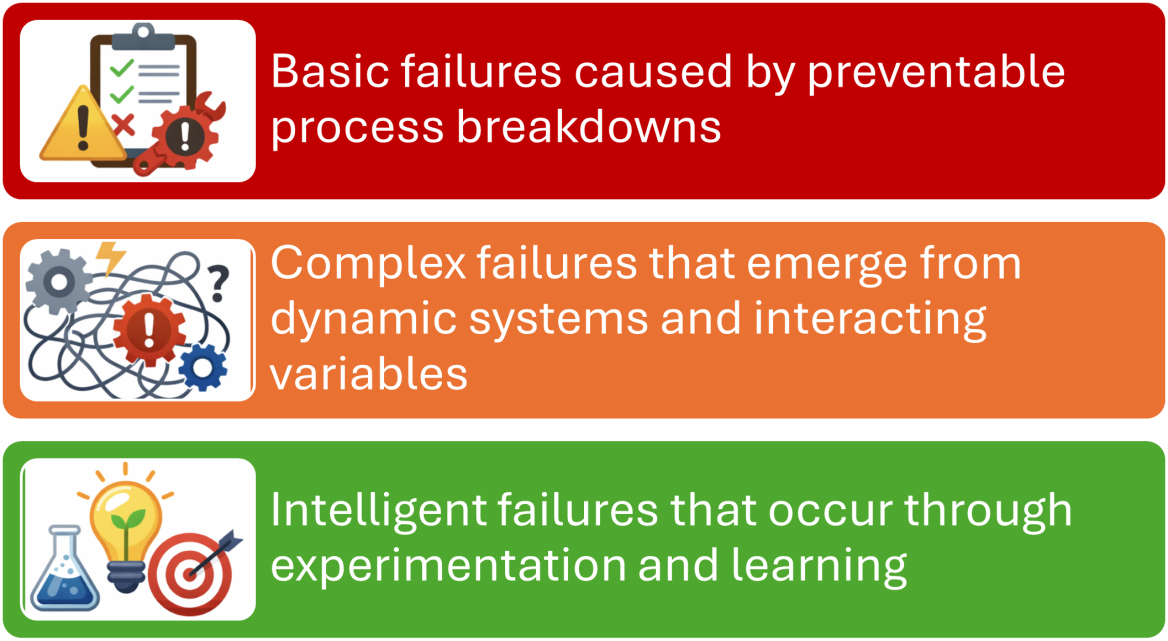
In complex work environments, she identifies three types of failures (Edmondson, 2011):

In learning and workforce development initiatives, all three can occur. The goal is not to eliminate failure entirely — it is to prevent the preventable, respond quickly to complexity, and learn from experimentation.

That requires psychological safety.

We tell our teams clearly:

“If you see something, say something. There is no blame for raising a concern. Silence is the risk.”

Creating this environment requires leaders and team members who actively support one another and approach challenges with curiosity rather than criticism. Maintaining a positive, solutions-oriented mindset (even when addressing problems) helps teams stay focused on learning and improvement. When team members feel comfortable surfacing issues early (whether related to scope, stakeholder alignment, or instructional design) small signals become early course corrections instead of project disruptions.

When something does go wrong, we address it openly and conduct a debrief focused on learning rather than blame. Research shows that teams with high psychological safety are significantly more effective at identifying and correcting errors (Edmondson, 1999).

Psychological safety isn’t just a cultural value. In complex learning initiatives, it is one of the most practical risk management strategies a team can build.

Data-Informed Contingency Planning

The most effective contingency plans are not based on guesswork — they are grounded in data.

During a large statewide conference we managed, a presenter had to withdraw from three sessions due to a medical emergency. Instead of scrambling, we activated a contingency plan informed by attendee data that showed which topics had the highest demand.

The same principle applies to instructional design projects. Needs assessments, learner analysis, and evaluation data from previous initiatives help guide decisions when timelines shift or scope changes.

Data transforms contingency planning from improvisation into informed response.

A Simple Risk Mitigation Checklist for Learning Projects

Before launching a learning initiative, our team uses a short checklist to ensure key risk considerations are addressed early in the process.

Risk Mitigation Checklist
This checklist reflects a simple principle: anticipating challenges early allows teams to respond with confidence later.

The Bottom Line: Risk Management Is About Trust

Organizations invest in learning solutions because they want measurable improvement in performance. Delivering on that promise requires more than strong instructional design — it requires anticipating everything that could stand between the learning experience and the desired outcome.

When disruption occurs (and in complex work it inevitably will) the way a team responds defines its credibility.  Clients, learners, and partners do not expect perfection. What they value is competence, transparency, and calm execution.

Strong risk management does not eliminate uncertainty. What it provides is something far more valuable: the confidence, capability, and resilience to navigate complexity — and still deliver meaningful results.

Ultimately, strong risk management reflects the same principles that guide our work every day: showing up prepared, maintaining a positive and solutions-focused mindset, and supporting partners and colleagues through challenges. When teams operate with that foundation, they build the trust that allows complex projects to succeed.