
Employers, What Piece of the Apprenticeship Puzzle Are You Missing?
Jill Monte
- Content Specialist
·
Oct 27, 2026
Employers, What Piece of the Apprenticeship Puzzle Are You Missing?
A conversation with Adina Tayar, EDSI Regional Apprenticeship Manager

Workforce development. Registered apprenticeship. Pre-apprenticeship. Work-based learning. You’ve heard the terms, and you probably know your organization should be doing more with apprenticeship – but something keeps getting in the way.
At EDSI, we have spent over four decades in workforce development – and the last six years building deep expertise in apprenticeship across industries, states, and populations.
In this first blog installment in The Apprenticeship Journey, Adina shares what she has seen work and stall. Her answer to ‘what piece is most often missing?’ might surprise you. It is rarely the paperwork. It is understanding that registered apprenticeship is an employer-built, employer-owned, multi-year investment – and having a plan to match.
The Short Version
- It is a journey, not a sign-up. The time goes into building, buy-in, funding, and training
- It is your program. Employers design it, fund it, run it, and own it
- Fit matters. A non-registered program can be the right answer
- EDSI is a guide, not a program administrator or compliance officer
First – How Long Does This Actually Take?
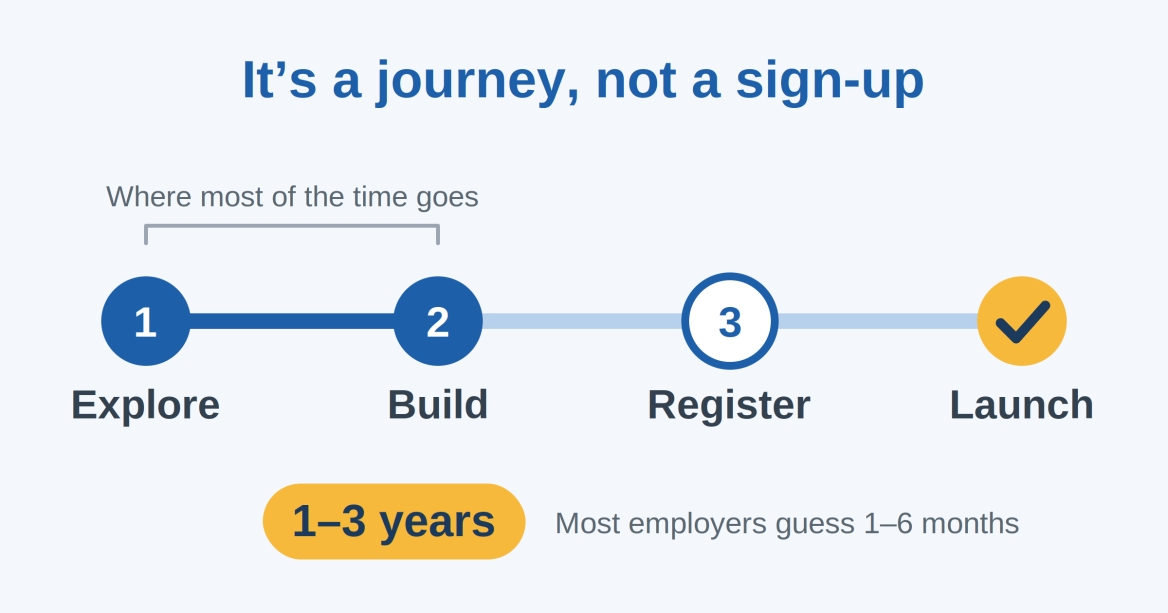
“From the time of the first exploratory phone call to the time that they actually registered a program, how long do you think that is? And everybody guesses like one month, six months. And I say – 1-3 years. And they respond, OH. And I say… it’s a journey.”
That aha moment is Adina’s favorite part of an apprenticeship conversation. It helps employers see that building a registered apprenticeship takes more than signing up or completing paperwork. It takes planning, commitment, and people who can move the work forward.
In Adina’s experience, that journey can take one to three years, depending on where the employer is starting and what needs to be built. Some already have training, mentors, and leadership support in place. Others are still figuring out which occupation makes sense or how they will fund the program.
Much of that time goes into the work before submission: choosing the occupation, building internal buy-in, mapping funding, designing the training, and lining up partners. The registration decision is one step in that larger process.
Employers who are simply handed information sometimes come back a year later, overwhelmed, because they didn’t realize how much was involved. A conversation up front, and dedicated support along the way, can make the process more manageable and help them build a program they can sustain.
What Is a Registered Apprenticeship, Really?
Every registered apprenticeship starts with a sponsor – the organization that registers the program and oversees it. A sponsor can be a single employer running its own program, or a group sponsor – such as an industry intermediary or training provider – that registers one program for many employers to run in their own organizations. A registered apprenticeship includes five core components:
- Industry-led – employer-driven and aligned to industry standards
- Paid job – apprentices are employees from day one, with raises tied to skill gains
- Structured on-the-job learning with mentorship – at least 2,000 hours
- Related instruction – coursework or certification training alongside the job
- Nationally recognized credential – portable and industry-recognize
Those five criteria are the same whether the occupation is in manufacturing, healthcare, or education. What can vary is the state process, the funding availability, and your organization's readiness.
For Private Employers
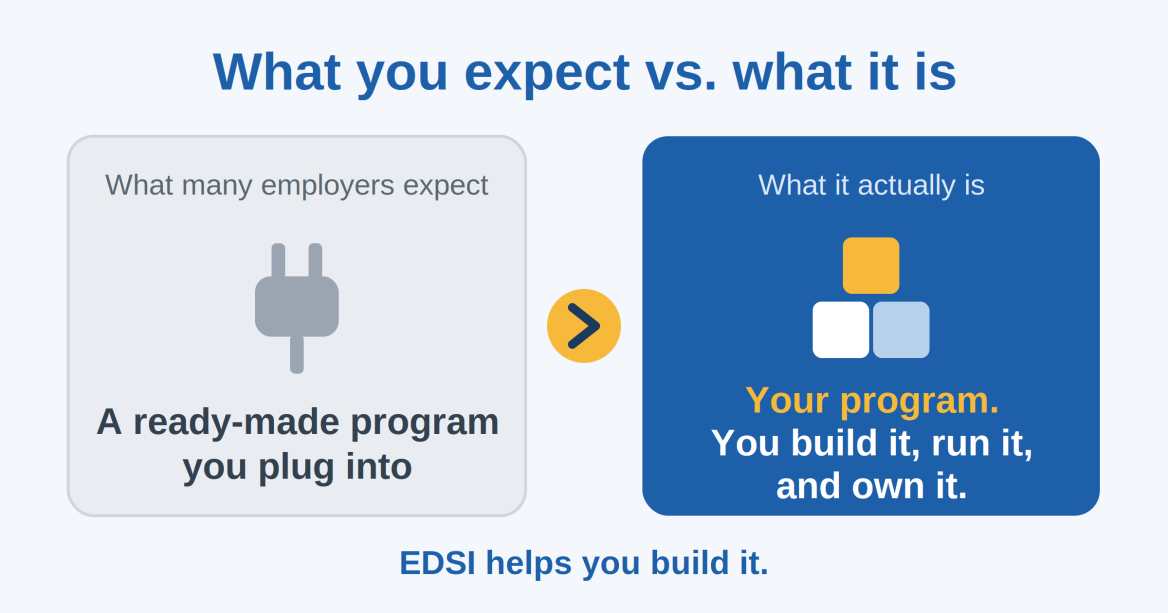
When employers first hear about apprenticeship, they often assume it’s a government program they can plug into.
“Employers think the government is running a program that they can access. They don’t understand that the government is actually promoting this as something that you will build and adopt for yourselves.”
Once Adina explains that a registered apprenticeship is the employer’s own program – built, funded, run, and owned by them – some lean in and some step back. Both outcomes are fine. The worst outcome is rushing to register a program you weren’t ready for, then watching it collapse when the funding plan falls apart or the internal champion leaves. That’s why EDSI treats the early conversation like a business consultation, not a sales pitch: we ask about strategy, staffing, training infrastructure, budget, and leadership alignment before we talk about paperwork.
Is the Job Apprenticeable?
Not every occupation is a fit for registered apprenticeship. A strong candidate involves skills that can be developed through structured on-the-job learning and related instruction. Manufacturing, transportation, behavioral health, and education all offer examples of occupations with registered apprenticeship pathways. The Apprenticeship Job Finder on Apprenticeship.gov is a useful starting point for exploring the possibilities.
Build it and run it at the same time.
“There’s no before, there’s no after. The cart and the horse are often built at the same time.”
Registration documents what you already do, so running the elements first turns the paperwork into a formalization. And plan to fund it yourself: outside dollars like WIOA or state grants are a bonus, not a baseline.
When Registered Apprenticeship Isn’t the Answer – and That’s Okay
“You don’t want to try and take the round peg and fit it into the square hole. If the registration requirements aren’t a good fit for your company, that is very important knowledge.”
Some employers already have structured training, mentorship, formal instruction, and progressive wages, but don’t want the compliance overhead of registration. An unregistered program that follows apprenticeship principles may be entirely appropriate.
What EDSI’s Role Actually Looks Like
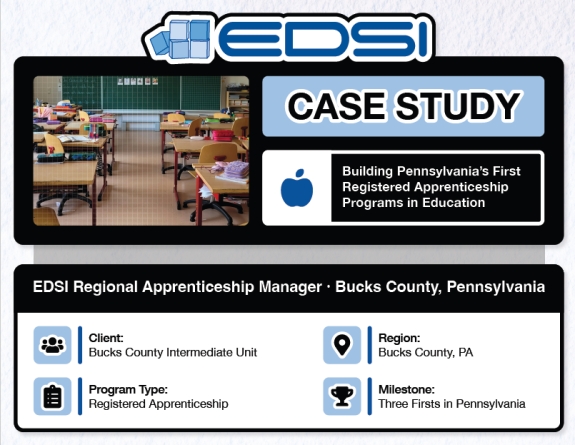
Bucks County Intermediate Unit (Bucks IU) came to EDSI with new staff, existing programs they were still learning to manage, and ambitions to build programs where no Pennsylvania model existed. Beginning in 2021, EDSI served as mentor, sounding board, funding navigator, and registration guide, connecting them to WIOA and ABA grant funding and the Keystone Apprenticeship Alliance. The result: three Pennsylvania-first programs – the Highly Qualified Teacher’s Aide Pre-Apprenticeship, the Registered Behavior Technician (RBT) Apprenticeship, and the Pre-K–12 Special Education Teacher Registered Apprenticeship – with more added since, and a staff that now largely runs them.
“We would not have developed the Bucks IU Educator Pathway as quickly or as efficiently without EDSI Regional Apprenticeship Manager Adina Tayar’s initial guidance and expertise. Whenever I had a question about funding, paperwork, or policy, Adina was just a phone call away.” – Jennifer Rawson, M.S., BCBA, Supervisor of Apprenticeship Programs, Bucks County Intermediate Unit #22
What EDSI Brings
Behind that approach is deep experience. EDSI has spent decades writing curriculum and building training programs, and guiding organizations that manage apprenticeship programs day to day – from the first design conversation through registration, launch, and ongoing operations.
Adina is helping a wide range of employers right now – from a trades-focused services company that needs an apprenticeship program to compete for government contracts, to an auto parts and repair business, to a biomedical research laboratory. The industries differ; the questions are the same: Is apprenticeship even an option for us? How do we fund it, build it, and explain it internally?
For private employers, the same applies:
A candid readiness and fit conversation before any paperwork
A realistic funding picture up front
Program and curriculum design–training plans, mentor and apprentice selection, related instruction and wage progression
Registration support, recruiting help, and ongoing guidance through launch and beyond
EDSI helps employers and sponsors navigate program design, funding options, registration, and implementation, while building their capacity to manage and sustain the program. See the full range of what EDSI offers on our apprenticeship page.
Ready to Start Your Apprenticeship Journey?
Whether you’re an employer exploring apprenticeship for the first time or a partner expanding your region’s footprint, EDSI can help you figure out what piece you’re missing. Tell us where you are today by filling out the short form below, and one of our team members will reach out to talk through next steps.
Coming next in The Apprenticeship Journey:
Blog 2: Apprenticeship and the Workforce System – How Workforce Boards and One-Stop Teams Can Build Apprenticeship Conversations Into Their Everyday Work.
Be sure to follow EDSI on LinkedIn, Facebook and Instagram to be notified when each new blog drops.